Lloyd D’Souza

I run the operational systems behind global creative at scale — and I’m building the next generation of them with AI.

Board Seat Soho Rep Theater Company NYC A nonprofit 501(c)(3) arts organization. Its mission is to be a “civic theater” that produces ambitious, innovative new works by radical theatermakers and provides them with high-caliber productions and tailored development at key points in their artistic careers.
Board Advisory Stealth AI Product AI Content Development Platform built for 360 development and execution. Currently being tested by filmmakers, writers, designers and copywriters.

Career Timeline

Mid 2000sLos Angeles

Development / Production.

My early years in my creative journey had me exploring my ideas in different ways. I worked in development at Warner Brothers and independent companies — reading screenplays, giving notes, meeting writers and directors, and shaping stories for the screen.

I directed music videos and short films, experimenting with different camera systems and lighting techniques, and working with diverse crews who shaped how I thought about a scene or a story.

I led a visual effects and post-production company that tackled massive jobs for major campaigns and smaller artistic explorations with some of the world's best designers and animators.

And I wrote my own screenplays — tapped by Oscar-winning producer Mark Johnson (Rain Man, The Narnia Franchise, Breaking Bad) to adapt a Sci-Fi novel he had acquired and subsequently sold.


01 Short Film
Last DanceVimeo
Last Dance
4 International Film Festival Screenings
02 Reel
Director reelVimeo
2011 Reel
Video
03 Music Video
Sabrosa PurrVimeo
Sabrosa Purr — Fashion Kills
Music Video

Los Angeles2012 → 2016

StarBeast Digital  |  Traction Avenue Films.

Co-Founded a multi-disciplinary production company at the intersection of narrative, experiential, and interactive.

With Traction Avenue Films I managed a roster of 10 directors — helping them shape opportunities, respond to briefs, and supporting production and delivery through StarBeast Digital.

StarBeast Digital was a VFX/Animation house that delivered memorable visuals for a John Mayer Tour, a Brand Jordan NBA All Star Weekend Interactive Activation, a Pilot for a Disney Animated series, and numerous other technically challenging but highly-rewarding projects.

As a small team, as much as I helped lead from an executive level, success required me to get my hands dirty on set, in post, and in pitches — invaluable to my growth as the industry shifted.

01 Spot
Nike · JordanVimeo
Nike Jordan — The Last Shot
Cannes Lions Winner
02 Reel
Company reelVimeo
StarBeast Digital — Company Reel
Video
03 Campaign
Conrad × TribecaVimeo
Conrad Hotels × Tribeca Film Festival
Video

Vox Creative2016 → 2018

Vox Creative  |  The Explainer Studio.

Executive Producer & Creative Director at Vox Creative — I helped lead the organization, pitch process development, and creative executions as Vox Media grew into a formidable and influential digital publisher.

Developed the visual language and creative directed the output of a brand identity that translated into photo, print, audio podcast segments, a brand video anthem, and OOH Times Square assets for the Vox Media: Go Deeper brand campaign that launched during AdWeek.

Partnered with Editorial to launch The Explainer Studio — a forward-thinking branded studio that capitalized on the incredible journalistic processes of the Vox editorial team and brought this thinking, diligence, and creativity to brand partners.

01 Studio
Vox × SpotifyYouTube
Explainer Studio × Spotify
Video
02 Trailer
Marriott × VoxVimeo
Marriott × Vox Media
Video
03 Anthem
Vox MediaVimeo
Vox Media Brand Anthem
Video

Condé Nast2018 → present12 markets

Global Video & Audio and the business underneath.

At Condé Nast, I lead global video and audio content development and operations — overseeing strategy, live production, franchise development, and podcasts across 12 markets for an iconic portfolio including Vogue, GQ, WIRED, and Vanity Fair. My teams deliver the industry's most significant cultural tentpoles, from the Met Gala and Vogue World to the Vanity Fair Oscar Party and GQ Men of the Year. During my tenure leading commercial video, branded revenue saw a 400% increase, and I transitioned GQ Sports from a nascent concept into a flagship franchise. Most recently, I took over the podcast division, launching new series across five brands. Partnering with Business Development, I am expanding the reach of our content, including securing a major licensing partnership with Netflix.

Beyond executive oversight, I focus on the complex systems that allow creativity to thrive at a global scale. My role involves identifying high-impact formats, establishing unified workflows for international teams, and eliminating the operational friction that hinders innovation. To support this, I have moved toward building proprietary technical solutions; I led the ideation and implementation of an AI-driven visual learning and optimization platform, developed in partnership with AWS and Twelve Labs, which is currently reactivating our extensive content archive across all digital formats.

Los Angeles New York Mexico City Paris London Munich Milan Madrid Dubai Mumbai Shanghai Taipei Tokyo

Markets · positions stylized

Global Brands: Vogue · GQ · AD · CNT · WIRED

01 Brand Reel
Condé NastVimeo
Condé Nast Brand Reel
Video
02 Tentpole
Vogue World 2025YouTube
Vogue World 2025
Video · YouTube live

2025 → presentLive wire

Building / AI Architecture.

Five things in motion right now.

01

Deployed
Inside Condé Nast

Condé Nast Channel Intelligence

An editorial video-intelligence dossier for Condé Nast editorial and audience leads — YouTube, TikTok and Instagram reads compiled from Databricks into a magazine-style briefing, with a resident AI Analyst.

02

Beta Testing
Condé Nast Prototype

Condé Nast Folio

A cross-brand editorial discovery app — fourteen mastheads cut into a numbered, dated edition that ends, with trainable AI Curators that read across titles.

03

In Use
Personal Build

Peripatos Hall

A private studio for writing and thinking alongside AI — Claude-powered collaborators modelled on historical figures, a shared library and a writers’ room.

04

In Development
Personal Build

Aither Horizon

A private intelligence desk for world politics — 75 trusted outlets and the GDELT event stream on one living map, sorting signal from noise.

05

Public Beta
Personal Build

Lone Wolf RPG

A full digital edition of Joe Dever’s Flight from the Dark — all 350 sections playable in a mobile-first gamebook that automates the bookkeeping and preserves the choices.

My early years in my creative journey had me exploring my ideas in different ways. I worked in development at Warner Brothers and independent companies — reading screenplays, giving notes, meeting writers and directors, and shaping stories for the screen.

I directed music videos and short films, experimenting with different camera systems and lighting techniques, and working with diverse crews who shaped how I thought about a scene or a story.

I led a visual effects and post-production company that tackled massive jobs for major campaigns and smaller artistic explorations with some of the world's best designers and animators.

And I wrote my own screenplays — tapped by Oscar-winning producer Mark Johnson (Rain Man, The Narnia Franchise, Breaking Bad) to adapt a Sci-Fi novel he had acquired and subsequently sold.
01Short Film
Last Dance
4 International Film Festival Screenings
02Reel
2011 Reel
Video
03Music Video
Sabrosa Purr — Fashion Kills
Music Video

Co-Founded a multi-disciplinary production company at the intersection of narrative, experiential, and interactive.

With Traction Avenue Films I managed a roster of 10 directors — helping them shape opportunities, respond to briefs, and supporting production and delivery through StarBeast Digital.

StarBeast Digital was a VFX/Animation house that delivered memorable visuals for a John Mayer Tour, a Brand Jordan NBA All Star Weekend Interactive Activation, a Pilot for a Disney Animated series, and numerous other technically challenging but highly-rewarding projects.

As a small team, as much as I helped lead from an executive level, success required me to get my hands dirty on set, in post, and in pitches — invaluable to my growth as the industry shifted.

01Spot
Nike Jordan — The Last Shot
Cannes Lions Winner
02Reel
StarBeast Digital — Company Reel
Video
03Campaign
Conrad Hotels × Tribeca Film Festival
Video

Executive Producer & Creative Director at Vox Creative — I helped lead the organization, pitch process development, and creative executions as Vox Media grew into a formidable and influential digital publisher.

Developed the visual language and creative directed the output of a brand identity that translated into photo, print, audio podcast segments, a brand video anthem, and OOH Times Square assets for the Vox Media: Go Deeper brand campaign that launched during AdWeek.

Partnered with Editorial to launch The Explainer Studio — a forward-thinking branded studio that capitalized on the incredible journalistic processes of the Vox editorial team and brought this thinking, diligence, and creativity to brand partners.

01Studio
Explainer Studio × Spotify
Video
02Trailer
Marriott × Vox Media
Video
03Anthem
Vox Media Brand Anthem
Video

At Condé Nast, I lead global video and audio content development and operations — overseeing strategy, live production, franchise development, and podcasts across 12 markets for an iconic portfolio including Vogue, GQ, WIRED, and Vanity Fair. My teams deliver the industry's most significant cultural tentpoles, from the Met Gala and Vogue World to the Vanity Fair Oscar Party and GQ Men of the Year. During my tenure leading commercial video, branded revenue saw a 400% increase, and I transitioned GQ Sports from a nascent concept into a flagship franchise. Most recently, I took over the podcast division, launching new series across five brands. Partnering with Business Development, I am expanding the reach of our content, including securing a major licensing partnership with Netflix.

Beyond executive oversight, I focus on the complex systems that allow creativity to thrive at a global scale. My role involves identifying high-impact formats, establishing unified workflows for international teams, and eliminating the operational friction that hinders innovation. To support this, I have moved toward building proprietary technical solutions; I led the ideation and implementation of an AI-driven visual learning and optimization platform, developed in partnership with AWS and Twelve Labs, which is currently reactivating our extensive content archive across all digital formats.

01Brand Reel
Condé Nast Brand Reel
Video
02Tentpole
Vogue World 2025
Video · YouTube live
Deployed · inside Condé Nast

Condé Nast Channel Intelligence

An editorial video-intelligence dossier for Condé Nast editorial and audience leads — YouTube, TikTok and Instagram reads compiled from Databricks into a magazine-style briefing, with a resident AI Analyst.

Beta Testing · Condé Nast prototype

Condé Nast Folio

A cross-brand editorial discovery app — fourteen mastheads cut into a numbered, dated edition that ends, with trainable AI Curators that read across titles.

Personal build

Peripatos Hall

A private studio for writing and thinking alongside AI — Claude-powered collaborators modelled on historical figures, a shared library and a writers’ room.

In Development · Personal build

Aither Horizon

A private intelligence desk for world politics — 75 trusted outlets and the GDELT event stream on one living map, sorting signal from noise.

Public Beta · Personal build

Lone Wolf RPG

A full digital edition of Joe Dever’s Flight from the Dark — all 350 sections playable in a mobile-first gamebook that automates the bookkeeping and preserves the choices.

01

Deployed
Inside Condé Nast

Condé Nast Channel Intelligence

An editorial video-intelligence dossier for Condé Nast editorial and audience leads.

The Dossier

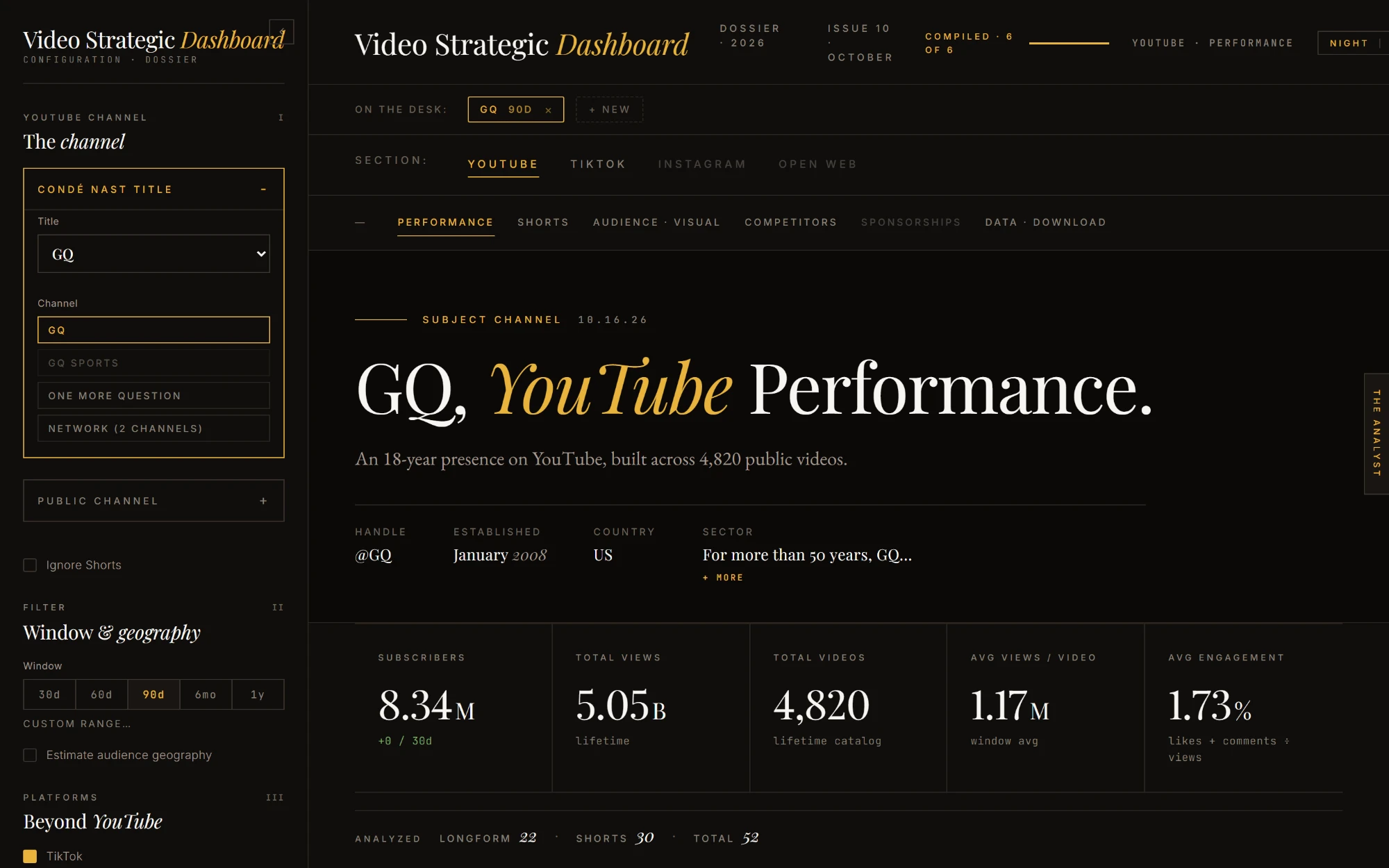
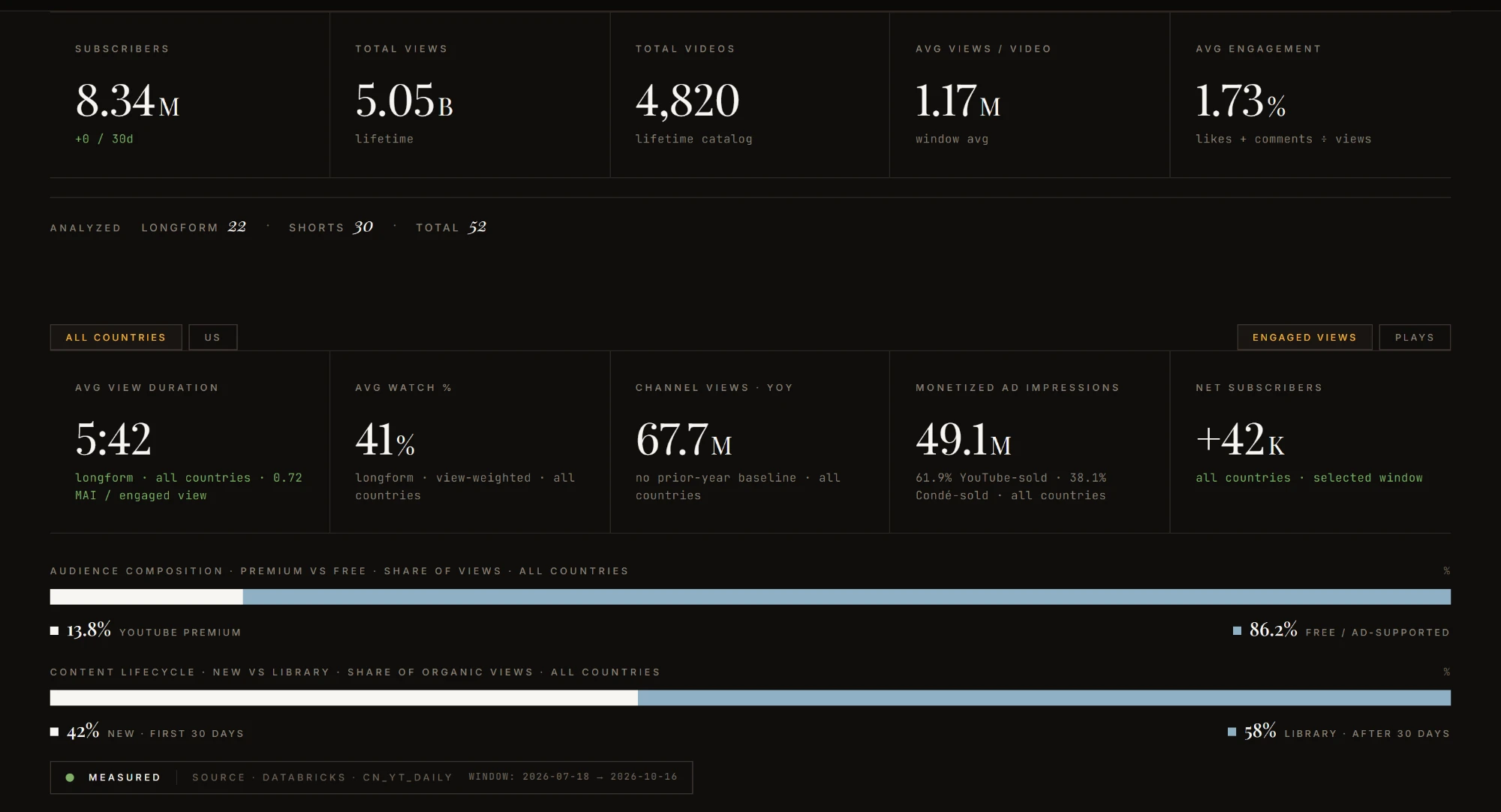
Channel Intelligence is an editorial video-intelligence dossier built for Condé Nast editorial and audience leads. Pick a title — GQ, Vogue, Bon Appétit, WIRED, The New Yorker and the rest of the U.S. portfolio — choose a channel or the title’s whole U.S. network, set a window, and it compiles a magazine-style briefing on how that channel is actually performing: the topline, the videos that carried the window, who watched and where they came from, what the Shorts business is doing, and how the owned TikTok and Instagram handles are moving alongside. It is designed to read like a briefing rather than a BI tool, and every number in it is one the leads can take into a programming or budget decision without caveats, because each one reconciles to the source it came from.

Channel Intelligence dossier: configuration sidebar and GQ YouTube performance header A Dossier
GQ · YouTubeScreen
Configuration & subject channel
Screen
Topline metrics, audience composition and content lifecycle B Topline
GQ · 90 daysScreen
Topline, composition & lifecycle
Screen

The Plug-ins

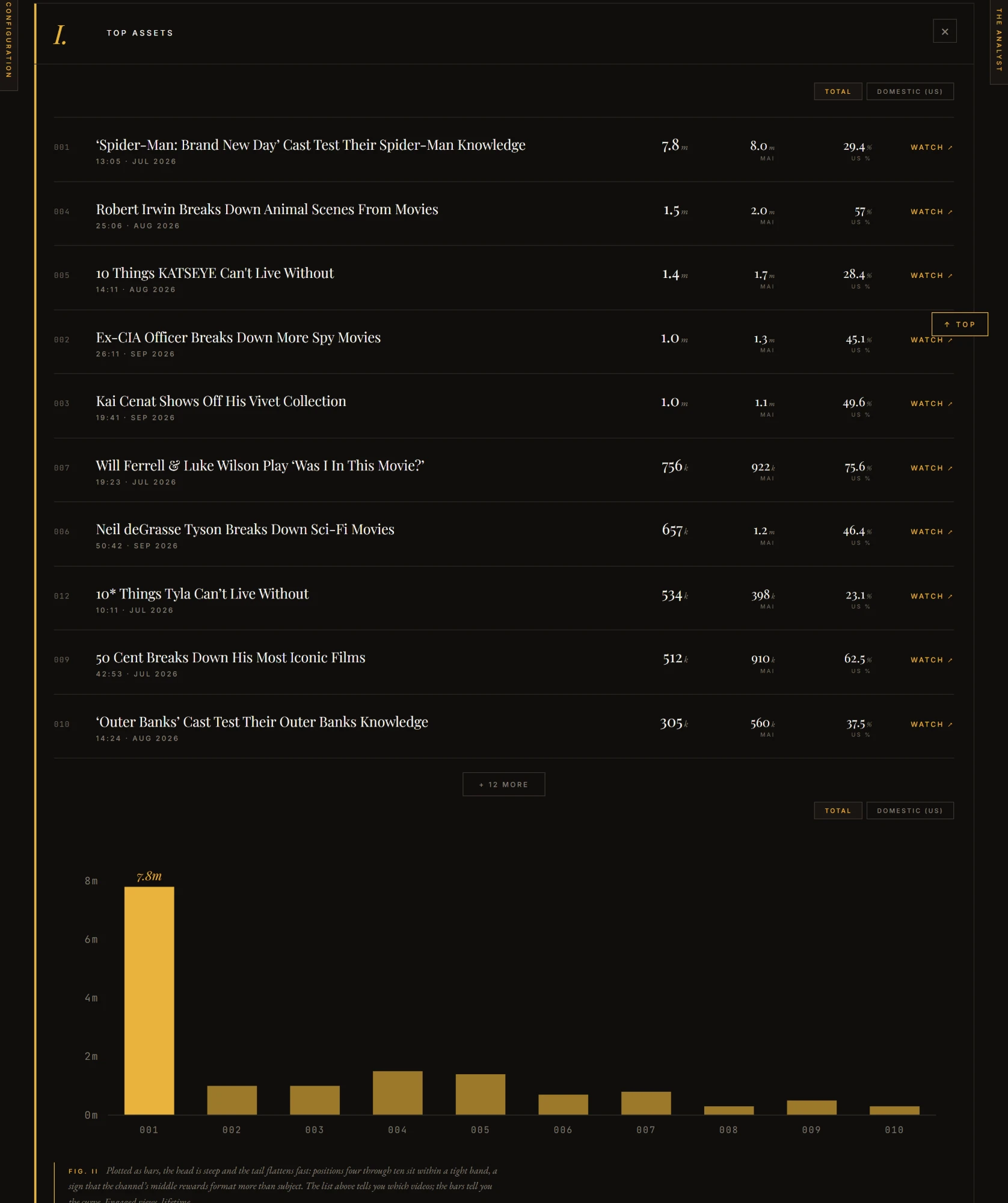
The dossier is modular. The YouTube layer carries the core reads — Performance, Shorts, Audience, Competitors, Sponsorships — and within each, a set of plug-in analyses expands on demand: Top Assets, Topic Terrain, Title Grammar, Hook Study, Length Signal, Cadence and Engagement Mapping, each an AI-drafted editorial read over the window’s uploads, reviewed by an editor. Beyond YouTube sit the owned-social layer (TikTok and Instagram from the company’s Dash Hudson data), Open Web listening for brand mentions, and a multi-dossier desk so several channels or windows can be open side by side and compared. Editorial context lives as data, not caption copy: a registry encodes channel lineage (a migrated channel’s history rides inside its successor), which channels a title offers, and which handles count — so the numbers change, rather than being explained.

Top Assets plug-in: ranked videos and bar chart C Plug-in
Top AssetsScreen
Top Assets — the head and the tail
Screen
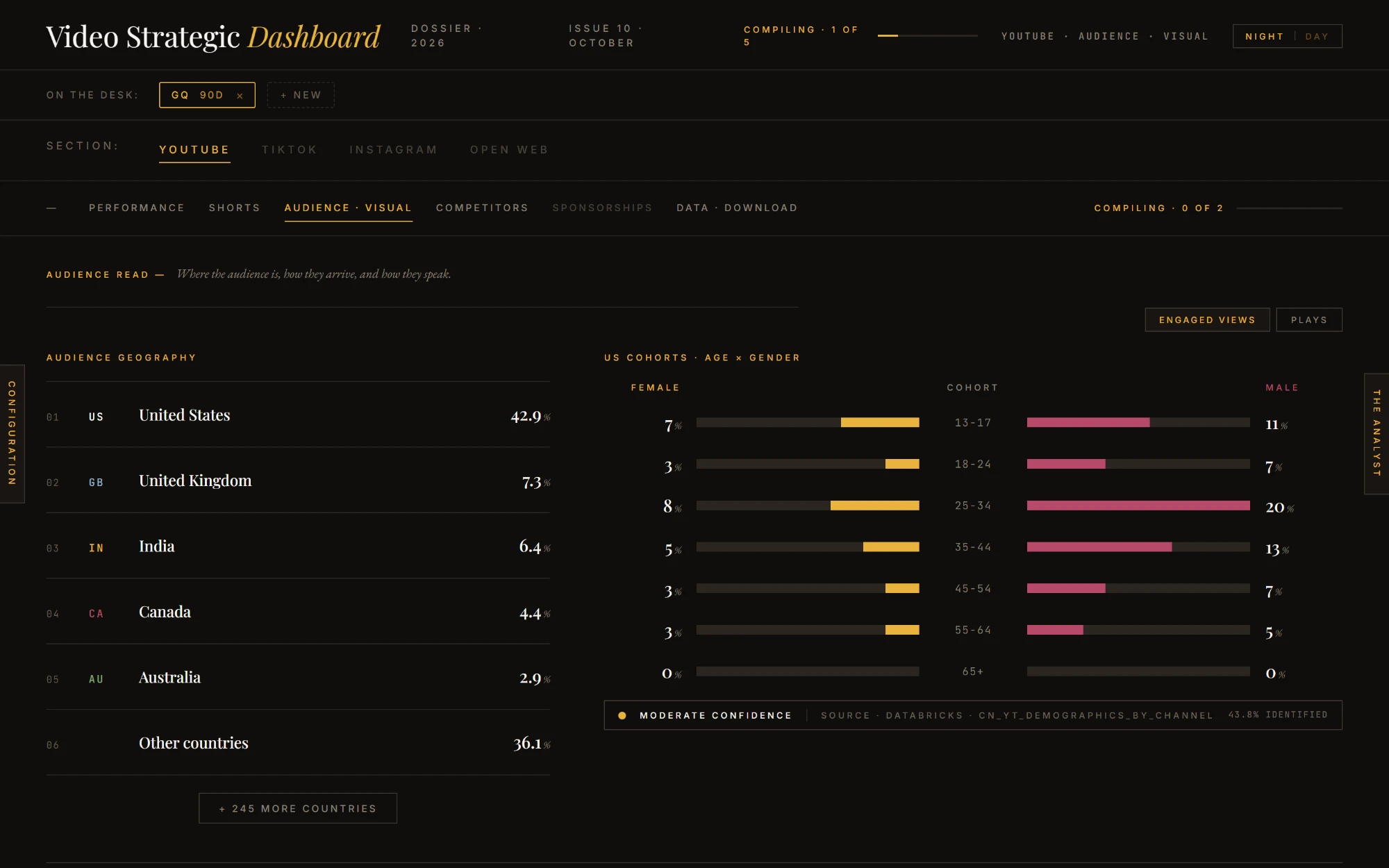
Audience read: geography and US age by gender cohorts D Read
Audience · VisualScreen
Audience — geography & cohorts
Screen
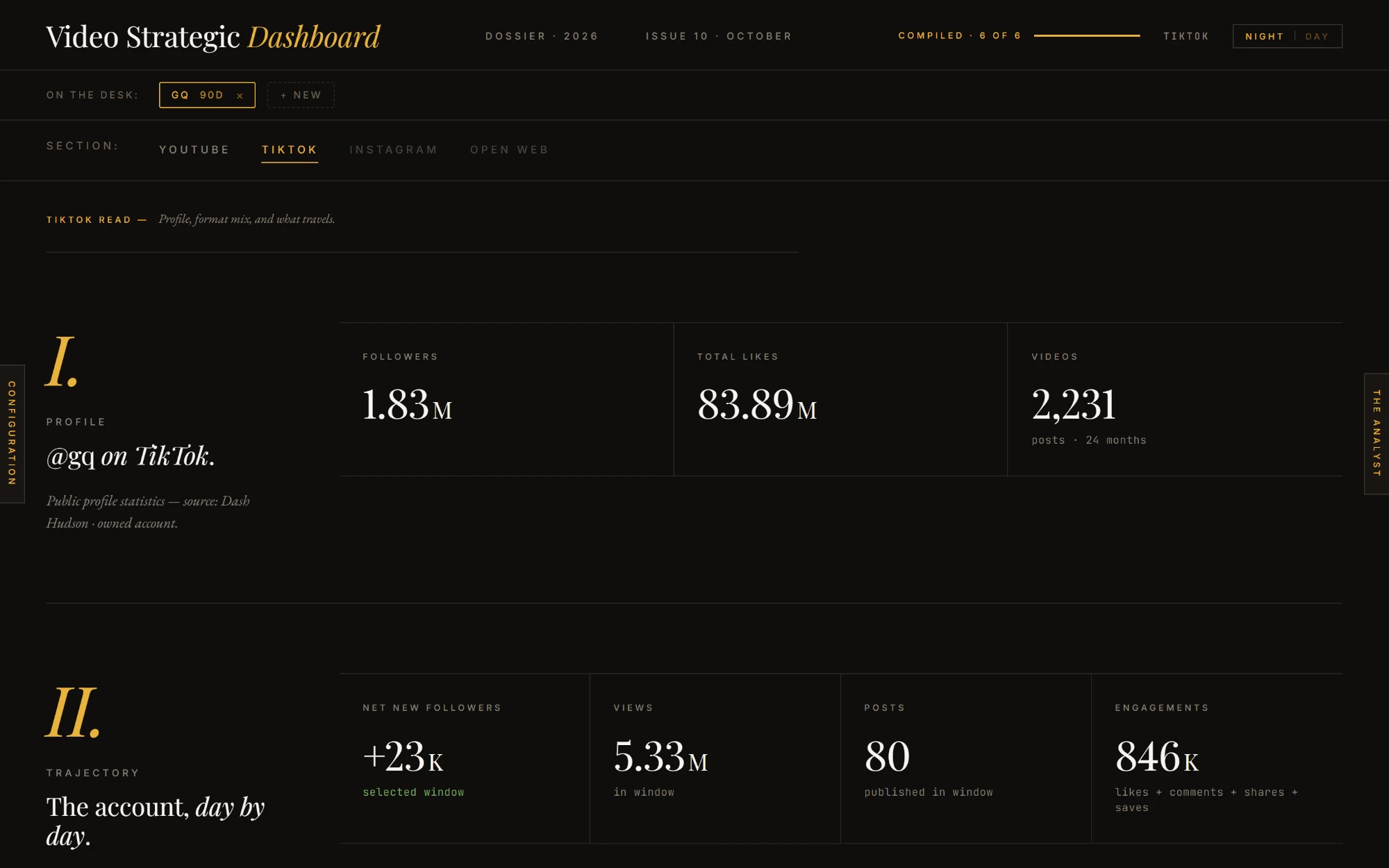
TikTok read: profile and trajectory metrics E Owned social
@gq · TikTokScreen
TikTok — profile & trajectory
Screen
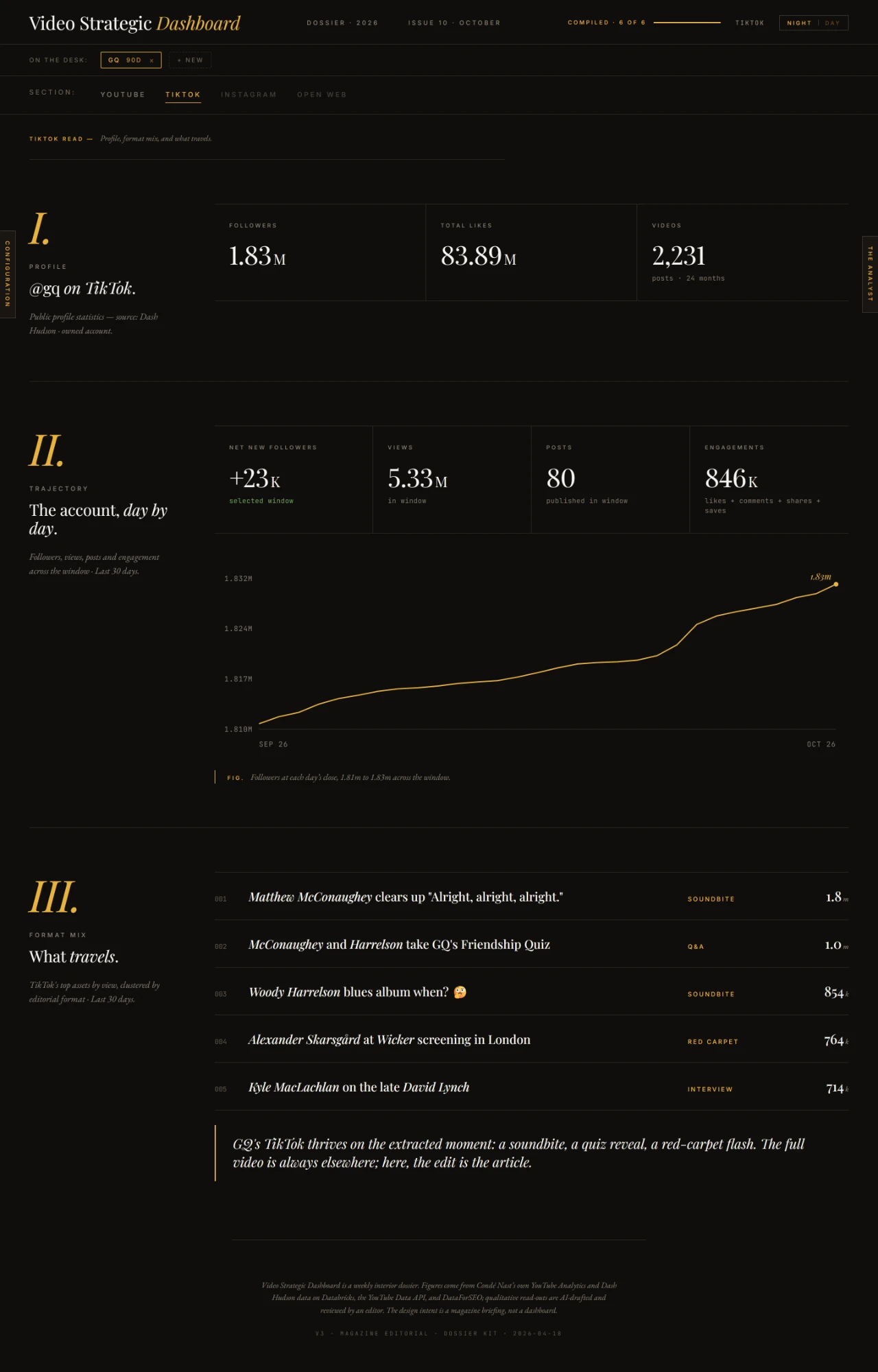
TikTok follower trajectory and format mix F Owned social
Dash HudsonScreen
TikTok — what travels
Screen

Under the Hood

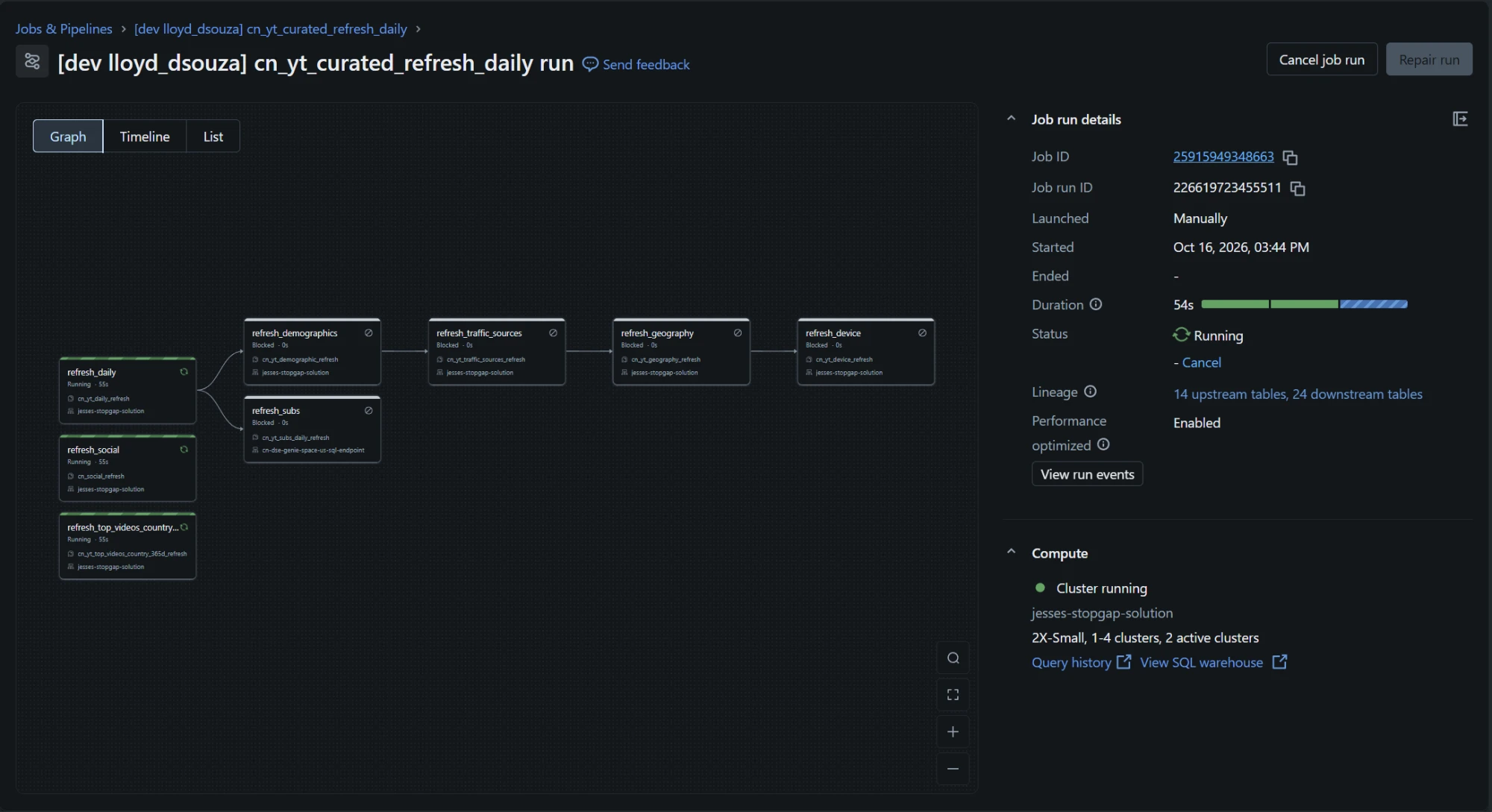
Underneath, a curated data layer does the work. A nightly job rebuilds two dozen tables in the company’s Databricks lakehouse from the raw YouTube Analytics and social extracts — channel-by-day, video-by-day, geography, demographics, traffic, devices, lifecycle, monetized ad impressions, owned-social posts — on a perimeter that matches what the leads select, with every table validated against YouTube Studio or Dash Hudson before it ships. Two decisions set its character. Engaged views, not the platform’s redefined “views”, are the house metric, with a toggle to see plays as reach; and year-over-year comparisons are withheld rather than shown when the two windows sit on different definitions. The app itself is a FastAPI service and a Next.js front end deployed as a single Databricks App, so the people reading it sign in with their company identity and the data never leaves the lakehouse.

Databricks job run: the nightly curated refresh pipeline G Pipeline
Databricks · nightly refreshScreen
Databricks job — the curated refresh, table by table
Screen

The Analyst

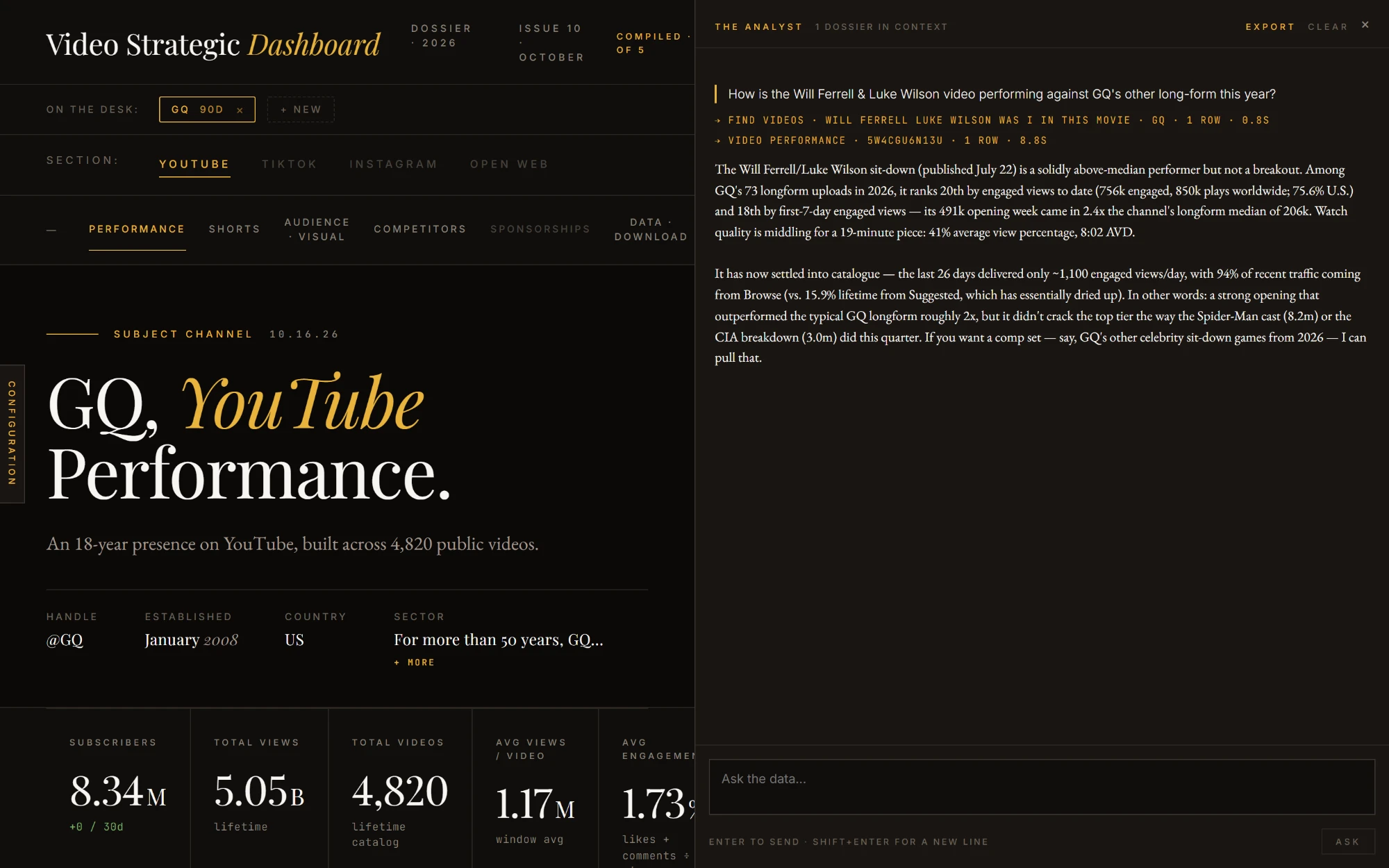
The Analyst is the dossier’s resident analyst — a side drawer you can talk to. It reads the dossiers open on your desk and, when a question reaches past them, pulls exactly what it needs through the same vetted queries the dashboard runs: any window, any channel, year-over-year, a specific video found by title and read against its peers, a ranked leaderboard for a custom period, monetized impressions, owned-social activity. It can also look outward — exact public counts for any channel on YouTube, and web search with sources for what is happening in the landscape — under a strict rule that curated, public and web figures are never blended and every figure is labelled with where it came from. It will not estimate revenue, because the booked number is not in its reach and an estimate would not be exact. Its value is less the answers than the time they take: a question that used to mean an export, a pivot and an afternoon is now a sentence, with the work shown, the numbers pulled live and the conversation exportable as a record.

The Analyst drawer answering a question about a GQ video's performance H The Analyst
Ask the dataScreen
The Analyst — a question, answered with the work shown
Screen
02

Beta Testing
Condé Nast Prototype

Condé Nast Folio

An edition, not a feed.

The Edition

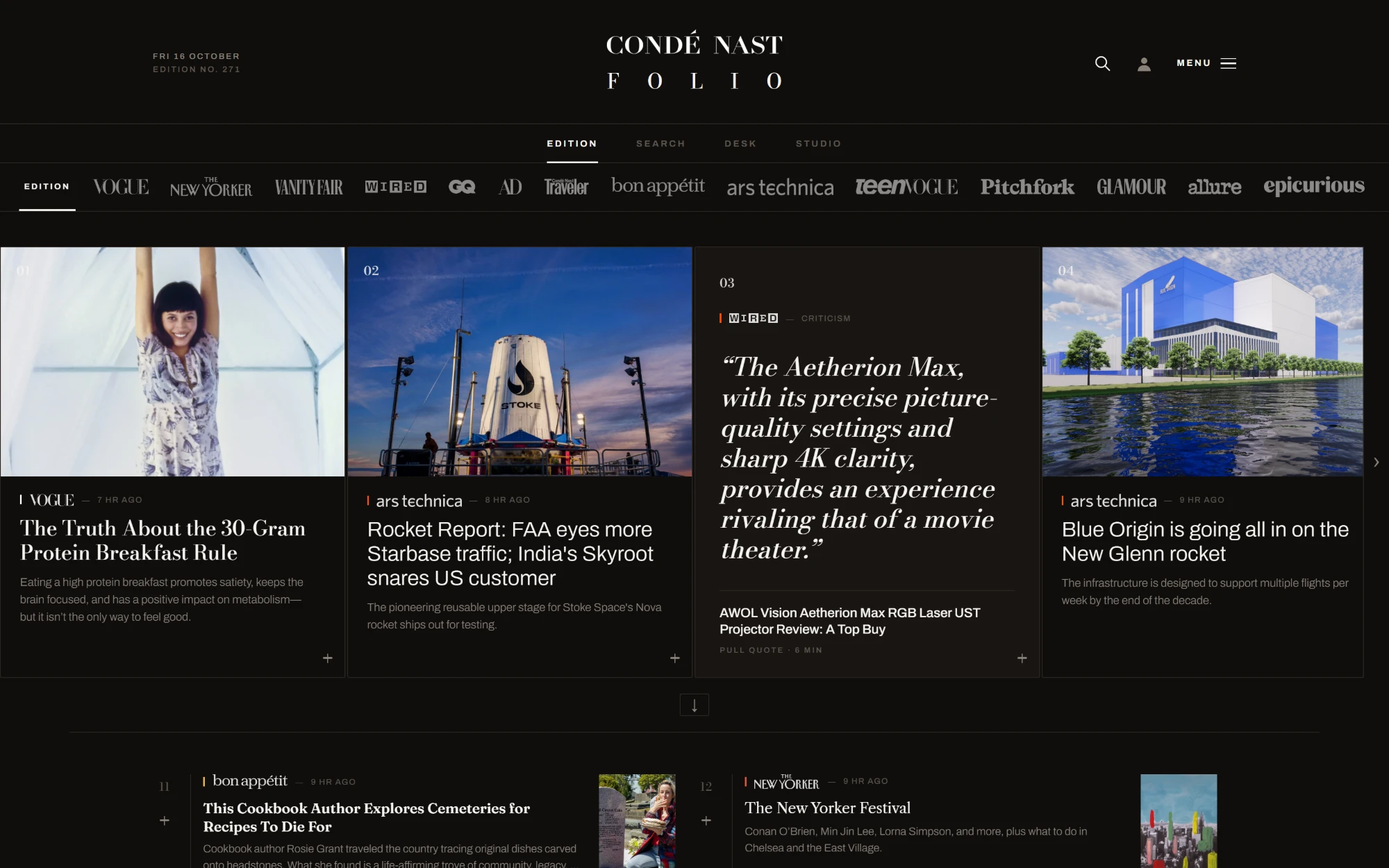
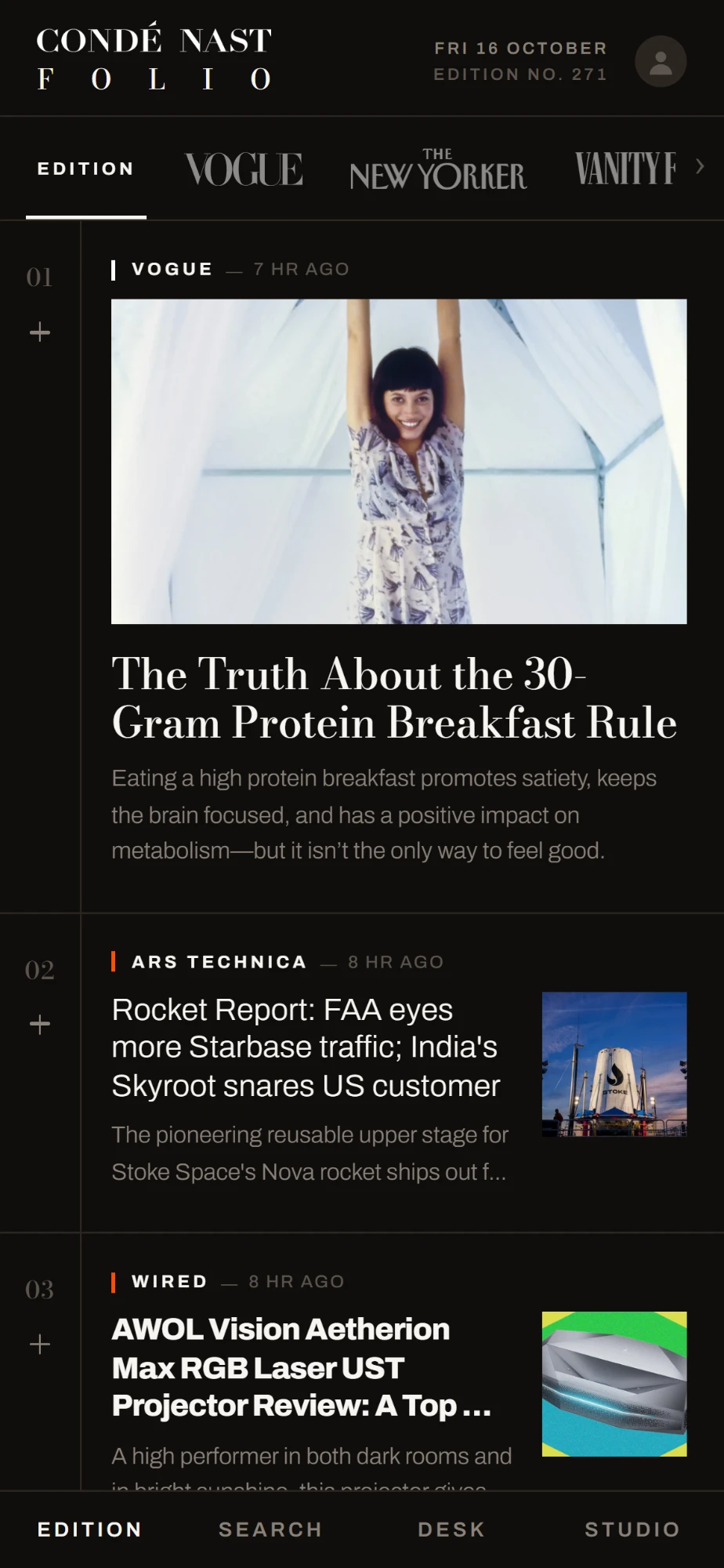
Folio is a cross-brand editorial discovery app for Condé Nast, built as a working prototype and running at condenastfolio.com. It gathers what fourteen mastheads publish — Vogue, The New Yorker, Vanity Fair, WIRED, GQ, Architectural Digest, Condé Nast Traveler, Bon Appétit, Ars Technica, Teen Vogue, Pitchfork, Glamour, Allure and Epicurious — and presents it the way a magazine would rather than the way a platform does: as a numbered, dated edition of twenty-four pieces that ends. There is no infinite scroll, no engagement loop and no algorithmic mystery. Every headline is set in its own masthead’s face, every piece opens on the publisher’s own site so the page view and the subscription stay with the brand, and the whole thing runs on a warm near-black ground that reads as a lookbook rather than a website. It installs to a phone’s home screen and, above 1024 pixels, lays the same screens out for a desk.

Folio's Edition on a desk: numbered lead cards, the pull-quote card and the grid beneath A Edition
Edition No. 271Desk
The desk — the lead row, the pull-quote card, the grid beneath
Screen

The Plug-ins

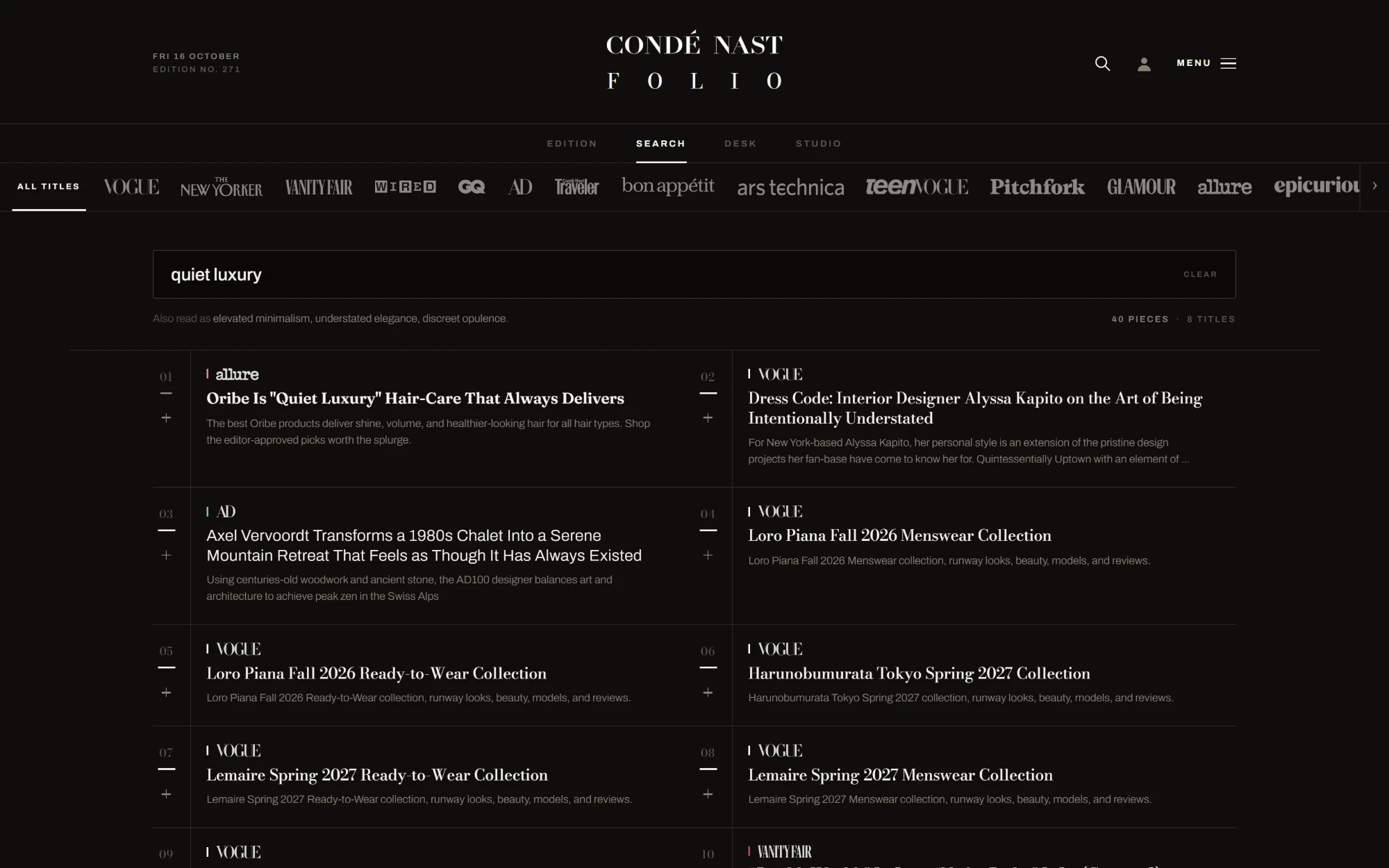
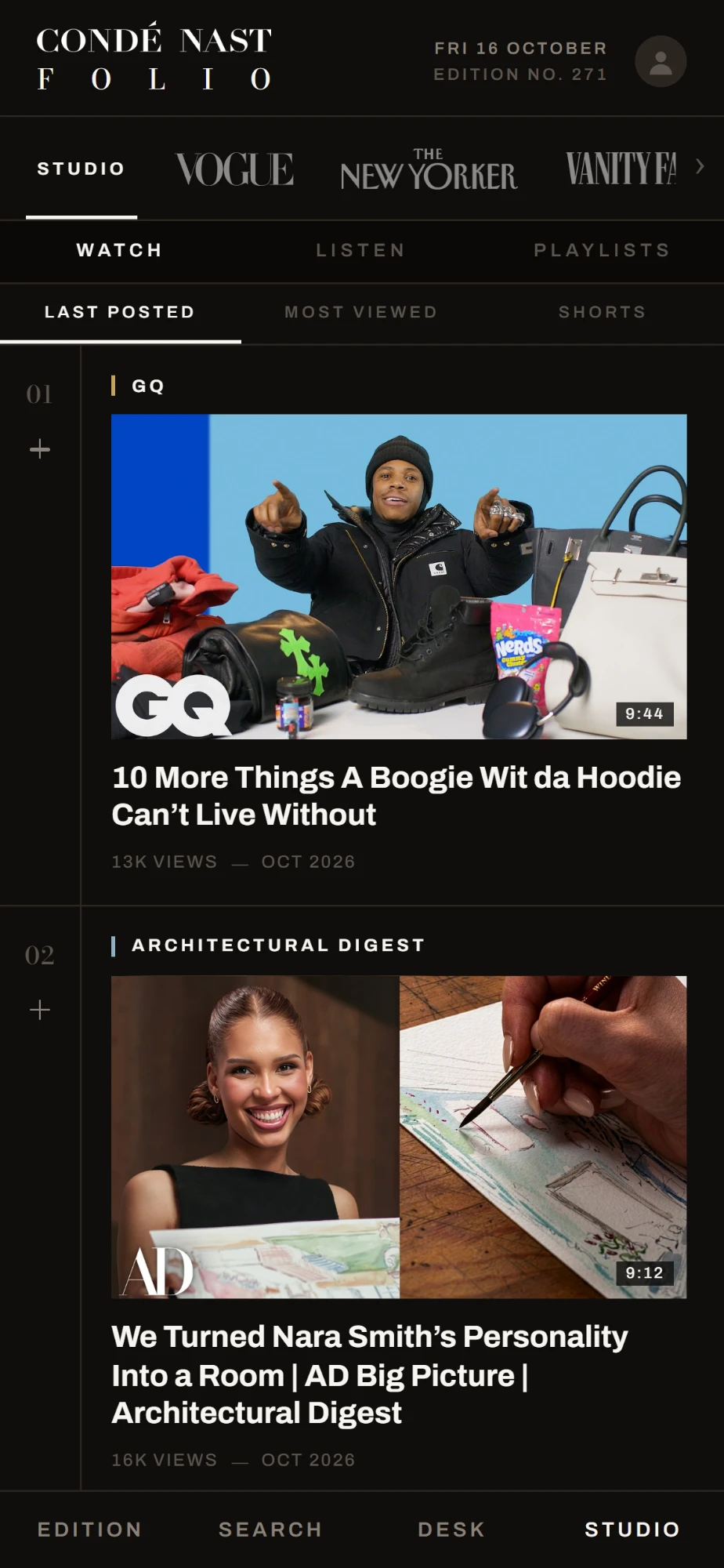
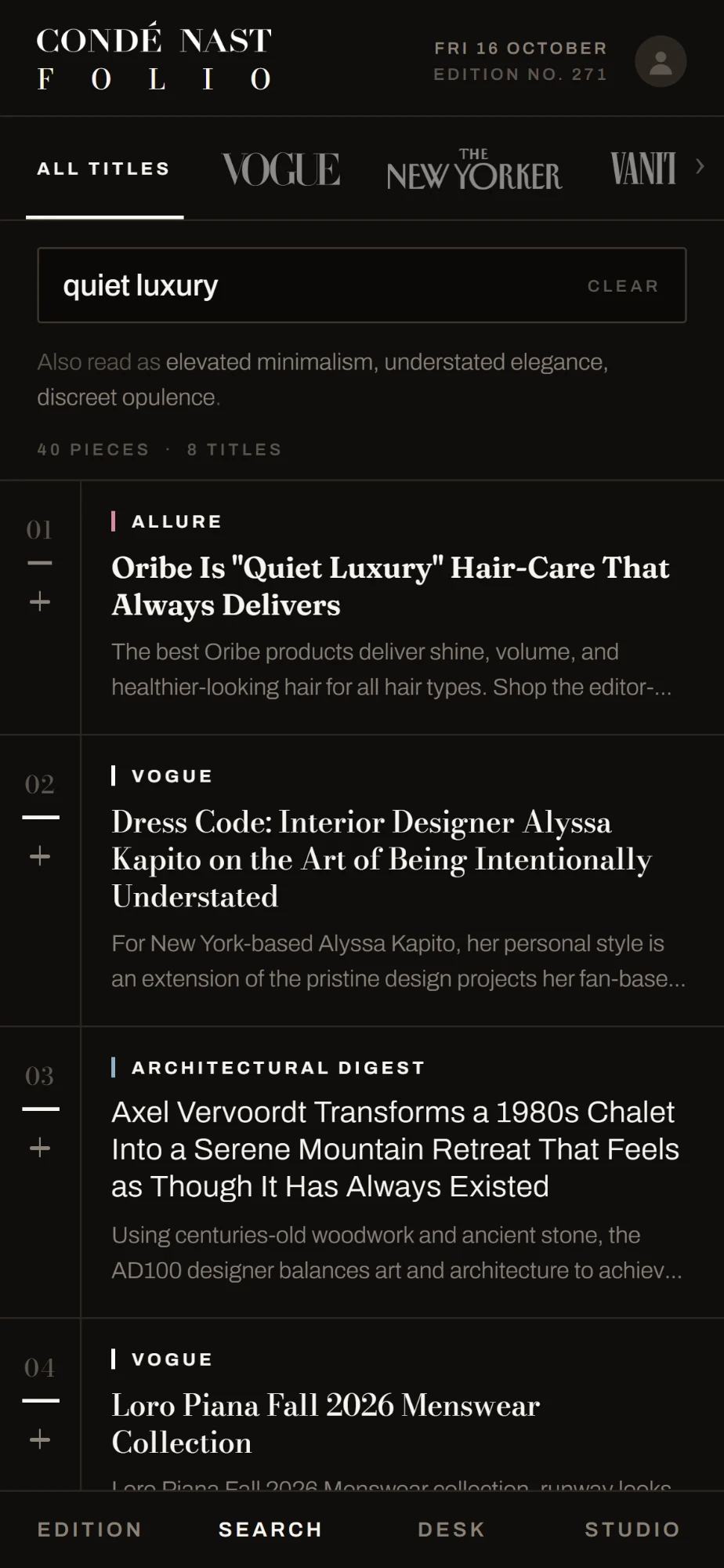
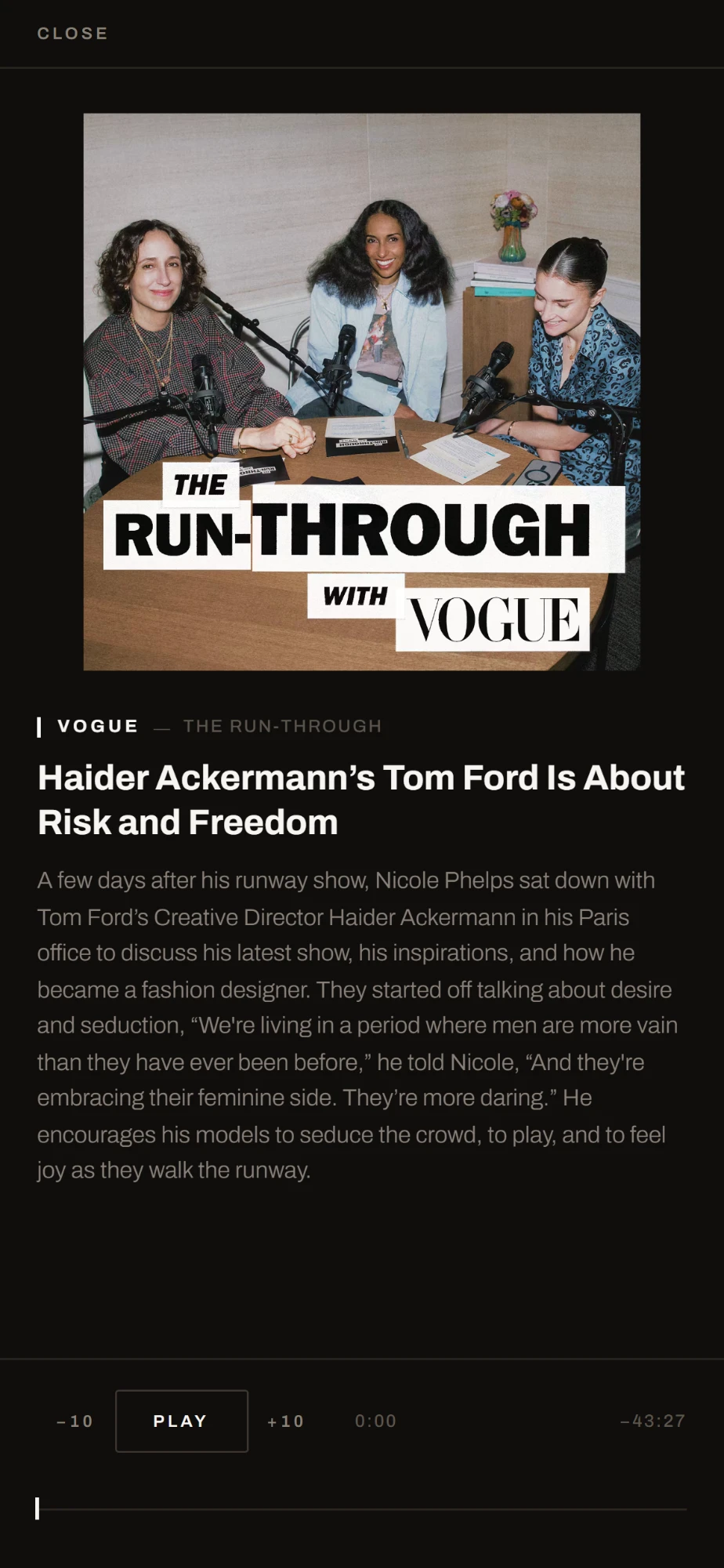
Several parts plug into that edition. An ingest job reads each masthead’s feeds twice a day and files roughly 21,000 articles, galleries and recipes, 38,000 videos and 3,000 podcast episodes into one catalogue, refusing coupon pages at the door. An enrichment job inside Condé Nast’s Databricks lakehouse reads each article’s body where it already lives, and writes back only derivatives — a word count, a pull quote in the writer’s own voice, three editorial labels and an embedding — so no article text ever leaves the workspace. Search runs a hybrid of keyword and vector retrieval with concept expansion, so “quiet luxury” finds Phoebe Philo and stealth wealth across six titles, most of them containing neither word. Studio holds the video and audio: YouTube clips behind the app’s own transport, podcasts playing in-app at the publisher’s own measured URL so every listen is still counted. Readers sign in with an email and a password, keep tearsheets of saved pieces and playlists of things to watch and listen to, and can opt into the Morning and Evening Editions — two emails a day cut from the edition by rules an editor would recognise, plus a Sunday Edition that looks back at the week.

Folio search for 'quiet luxury' on a desk: forty pieces from eight titles B Search
“Quiet luxury”Desk
Search — forty pieces from eight titles, the concepts read as a sentence
Screen
The Edition on a phone C
The Edition
Phone
Studio on a phone: the latest videos across titles D
Studio — watch
Phone
Search on a phone: 'quiet luxury' read as a concept E
Search as a concept
Phone
A Vogue podcast in Folio's own player F
Studio — listen
Phone

How It Works

How it works, mechanically, is a chain that runs on time. A small Cloudflare Worker fires three scheduled runs a day: the morning and evening ingests at 8am and 6pm New York, and a media run at 4pm. Each run writes to a Postgres database with vector search, embeds what is new, rebuilds the site so the front page is current to the minute, and, when the switch is on, sends the newsletter to everyone who opted in. The app is an Expo project deployed on Cloudflare Pages; the catalogue is baked into the bundle so nothing ships a database credential to a reader, and the few things that must be live — search, a title’s deeper archive, the curator’s conversation — run as serverless functions. Everything is covered by 500 offline tests that run without keys or a network, which means the whole system can be checked in a meeting.

The Curator

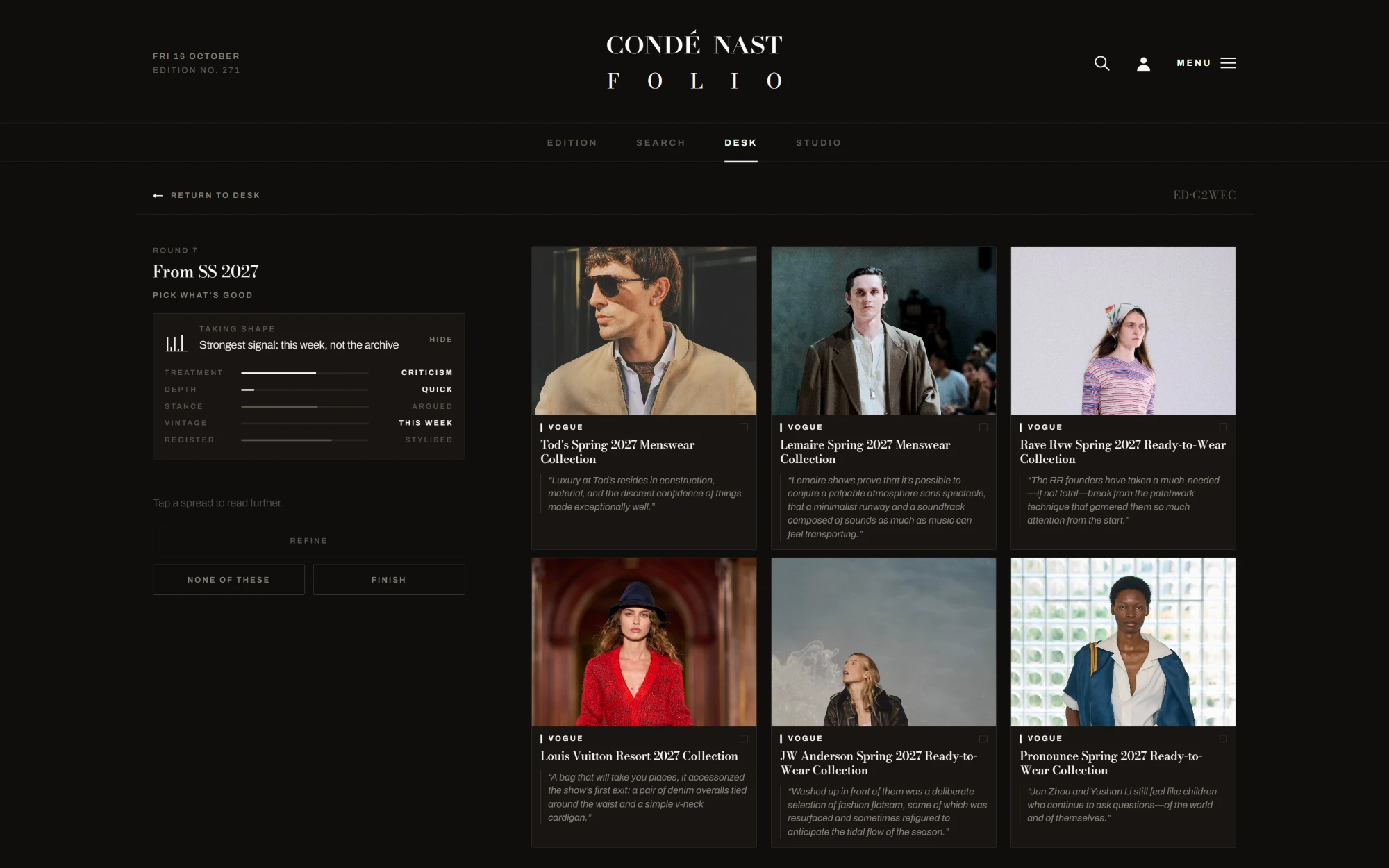
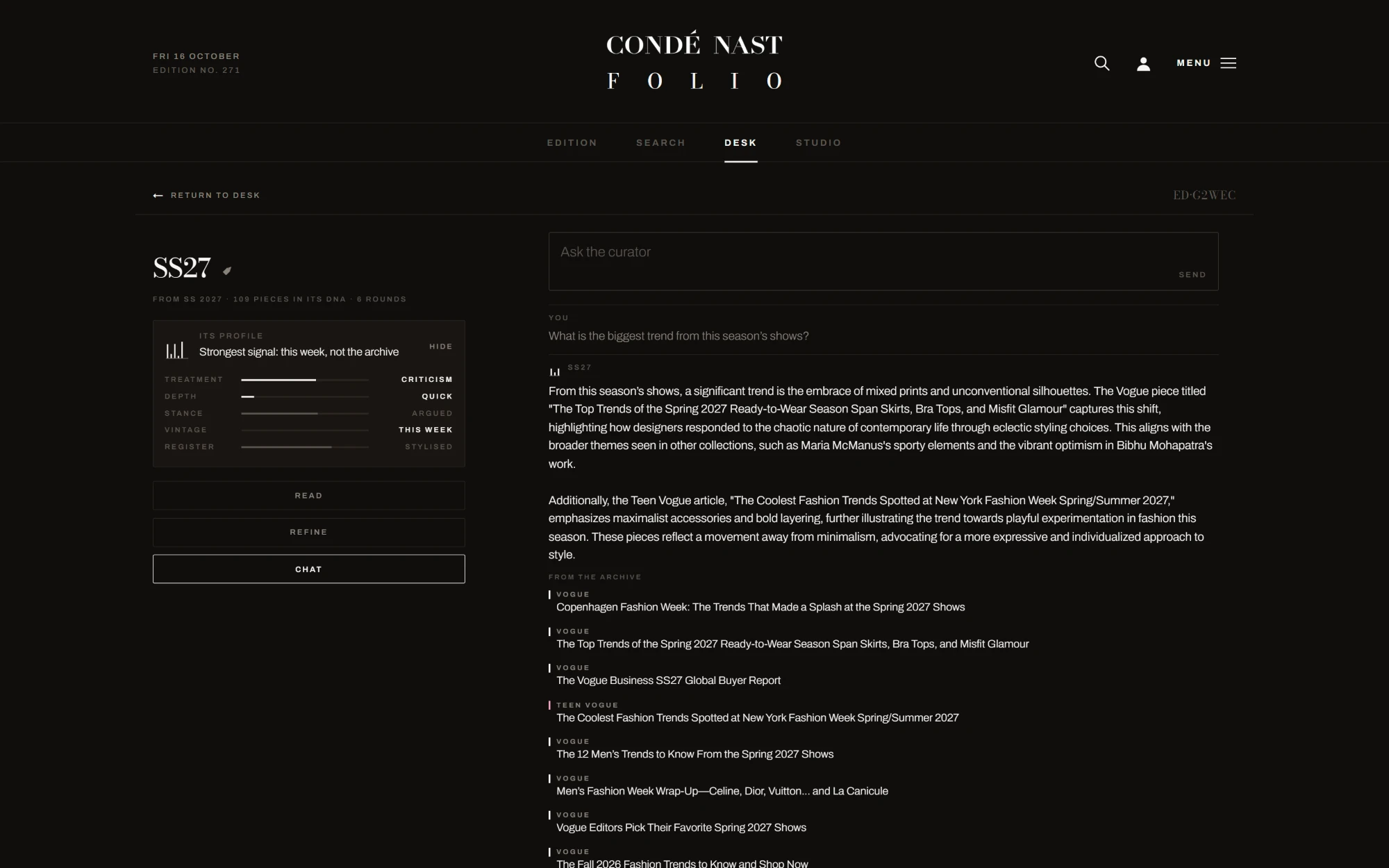
The Curator is the part no one else can build, and it is where the value sits. A reader trains one: they brief it with a subject, or seed it from a tearsheet they have already assembled, and then refine it a round at a time against six pull quotes drawn from the archive around its moving centre of taste — picking the ones that are right, passing on the ones that aren’t. From four picks it has a readable profile on five editorial dials: treatment, depth, stance, vintage and register. A finished curator offers three things: Read, the pieces it holds; Refine, more rounds; and Chat, an agent built from its taste that answers questions by searching the archive and ranking what it finds by relevance first and the curator’s dials second, surfacing real pieces the reader can open rather than describing them. The point is that taste crosses mastheads where brands cannot. A curator trained on one person’s fashion tearsheet will find the WIRED piece and the New Yorker essay that belong beside it, and that is a reading of fourteen titles that no single brand’s homepage, newsletter or recommendation engine could produce. For a company whose titles compete for the same attention, a curator is the first thing that makes them read as one.

Refining a curator: a round of six pull quotes and its taking-shape profile G Refine
Round 7 · SS27Desk
Refine — a round of six, the dials taking shape
Screen
Chatting with a trained curator: an answer with pieces from the archive H Chat
Ask the curatorDesk
Chat — answers drawn from real pieces in the archive
Screen
03

In Use
Personal Build

Peripatos Hall

A private studio for writing and thinking alongside AI.

The Hall

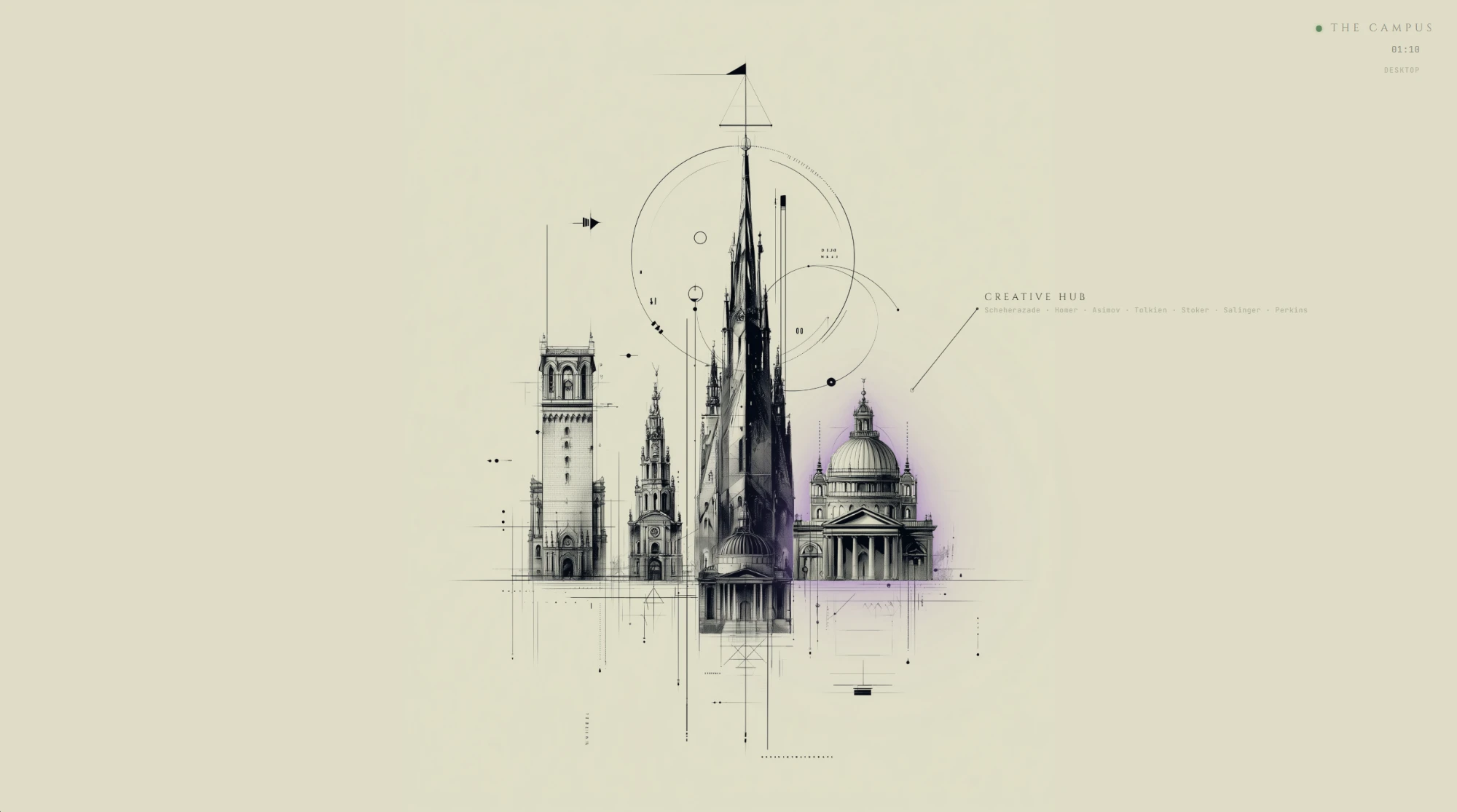
Peripatos Hall is a private studio I built for writing and thinking alongside AI. It takes its name from the peripatos, the covered walkway at Aristotle’s Lyceum where teacher and students worked through ideas on foot, in conversation. The Hall is a single web app drawn as an architect’s sketch of a small campus: a central spire, two scholars’ towers, a domed creative hub and a library. Each building is a room, and behind every door is a collaborator modelled on a historical figure, with a defined role, a distinct voice and access to a shared, growing library. It’s where I develop my screenplays and keep the research that feeds them.

The Peripatos Hall home screen: an architectural line drawing of five buildings around a central spire A The Hall
Peripatos HallScreen
The Hall — each building is a room
Screen

The Collaborators

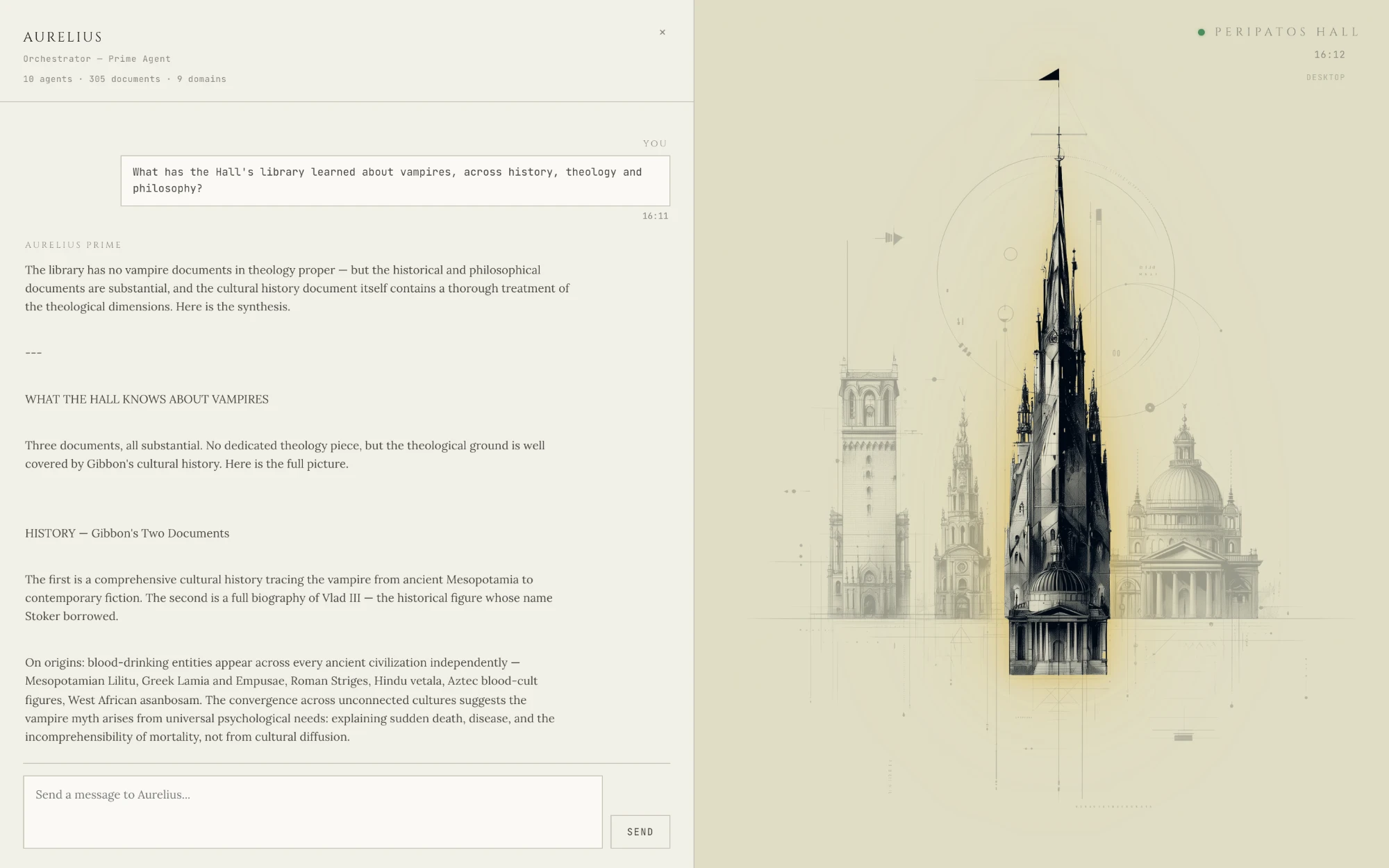
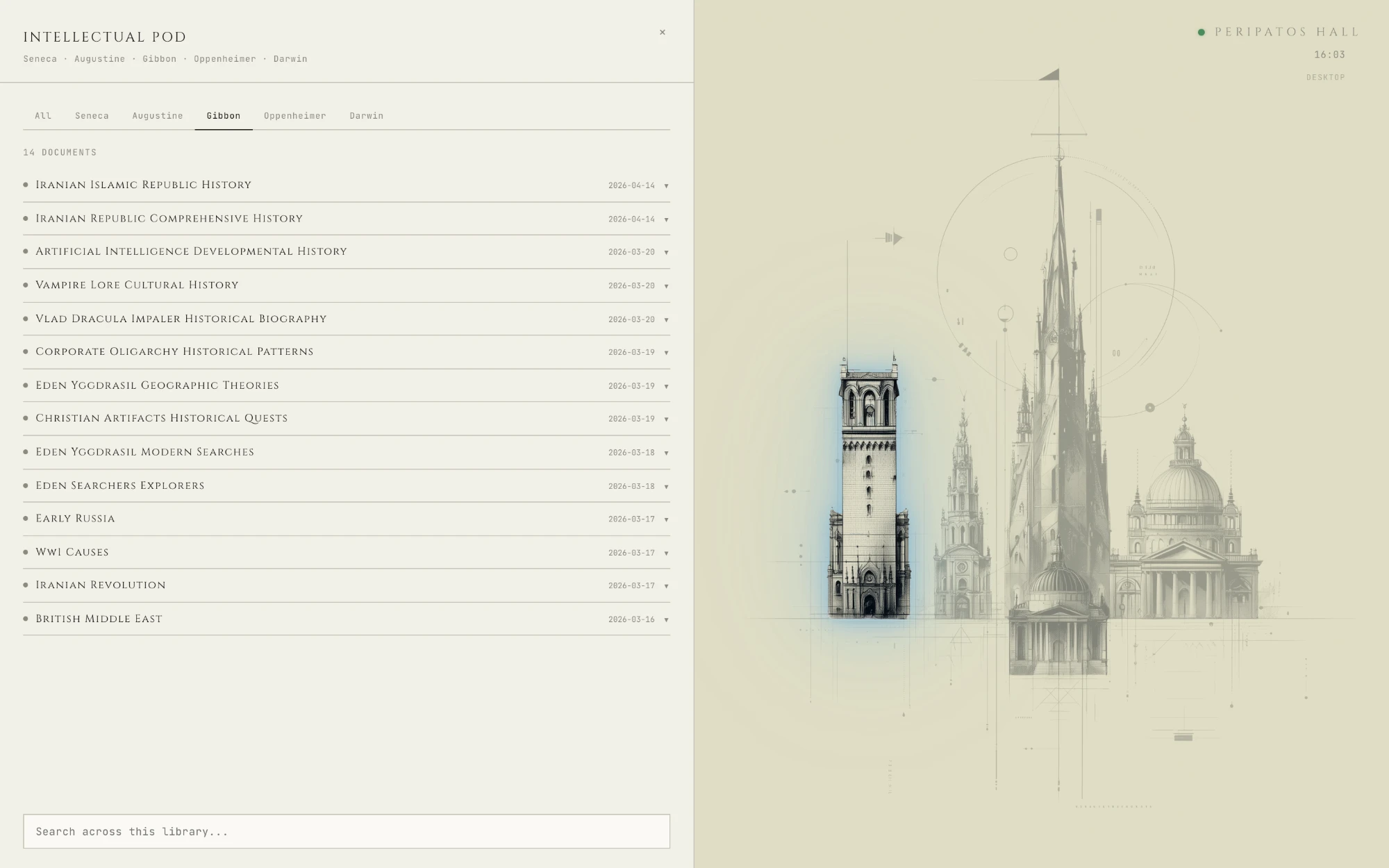
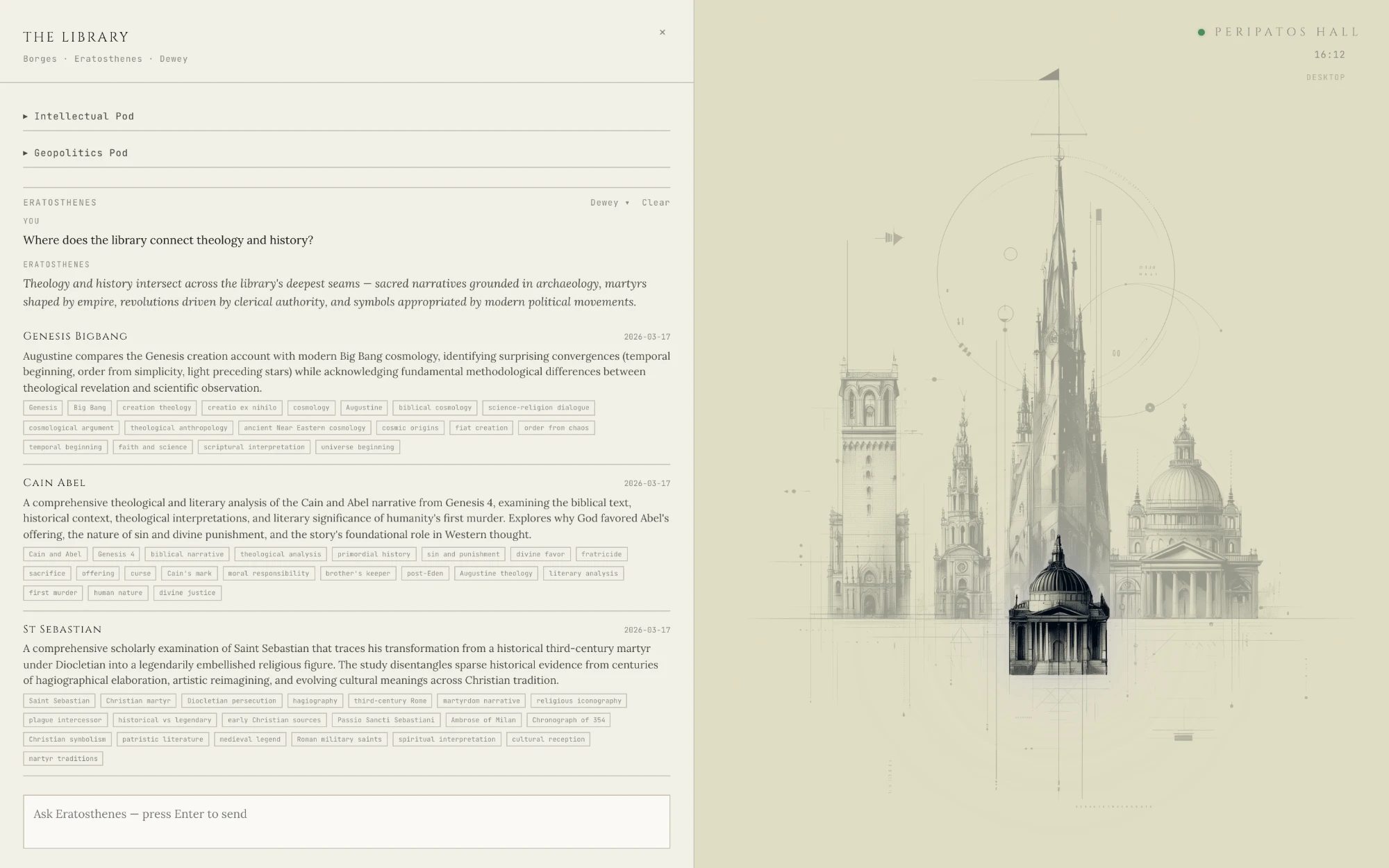
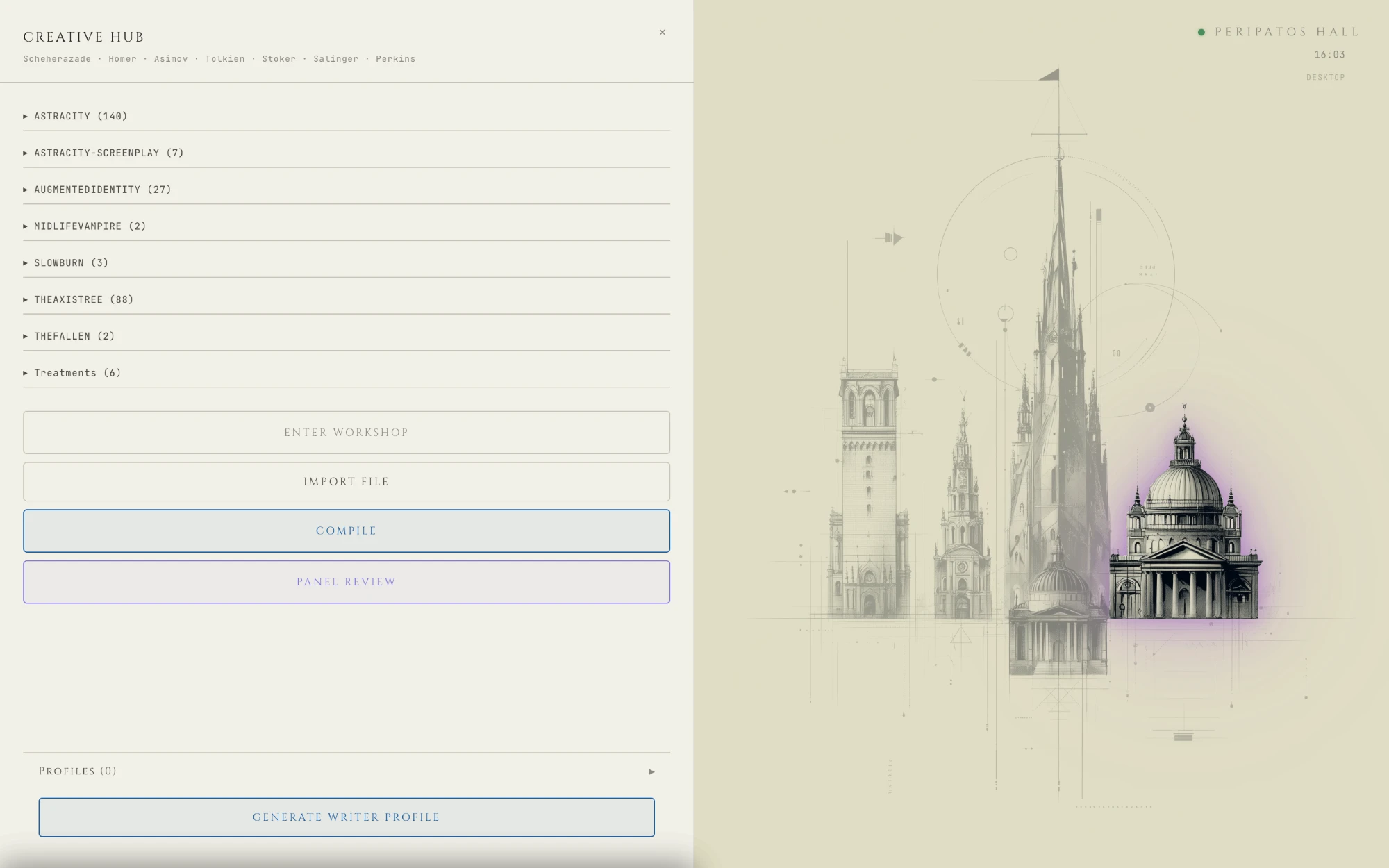
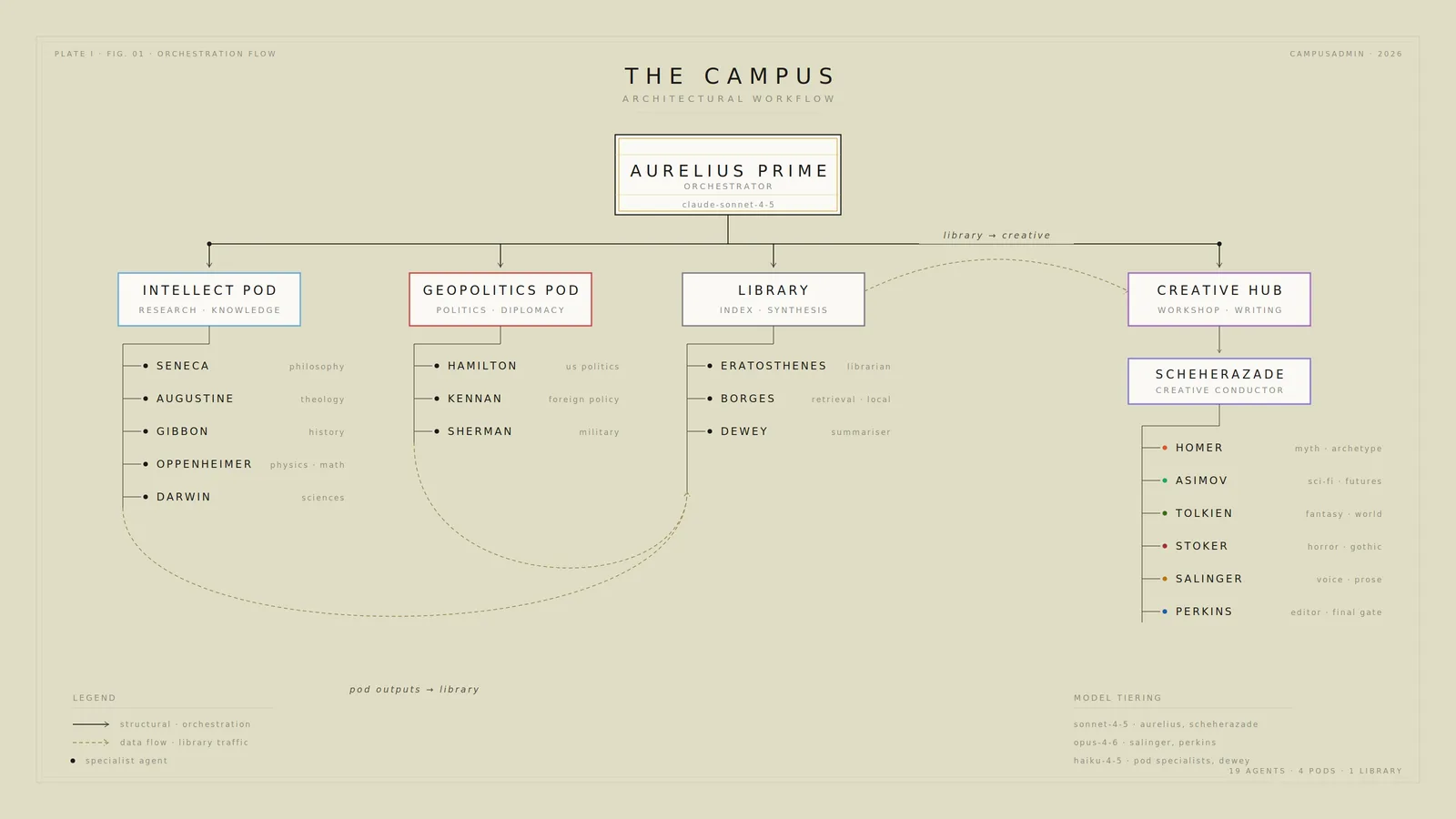
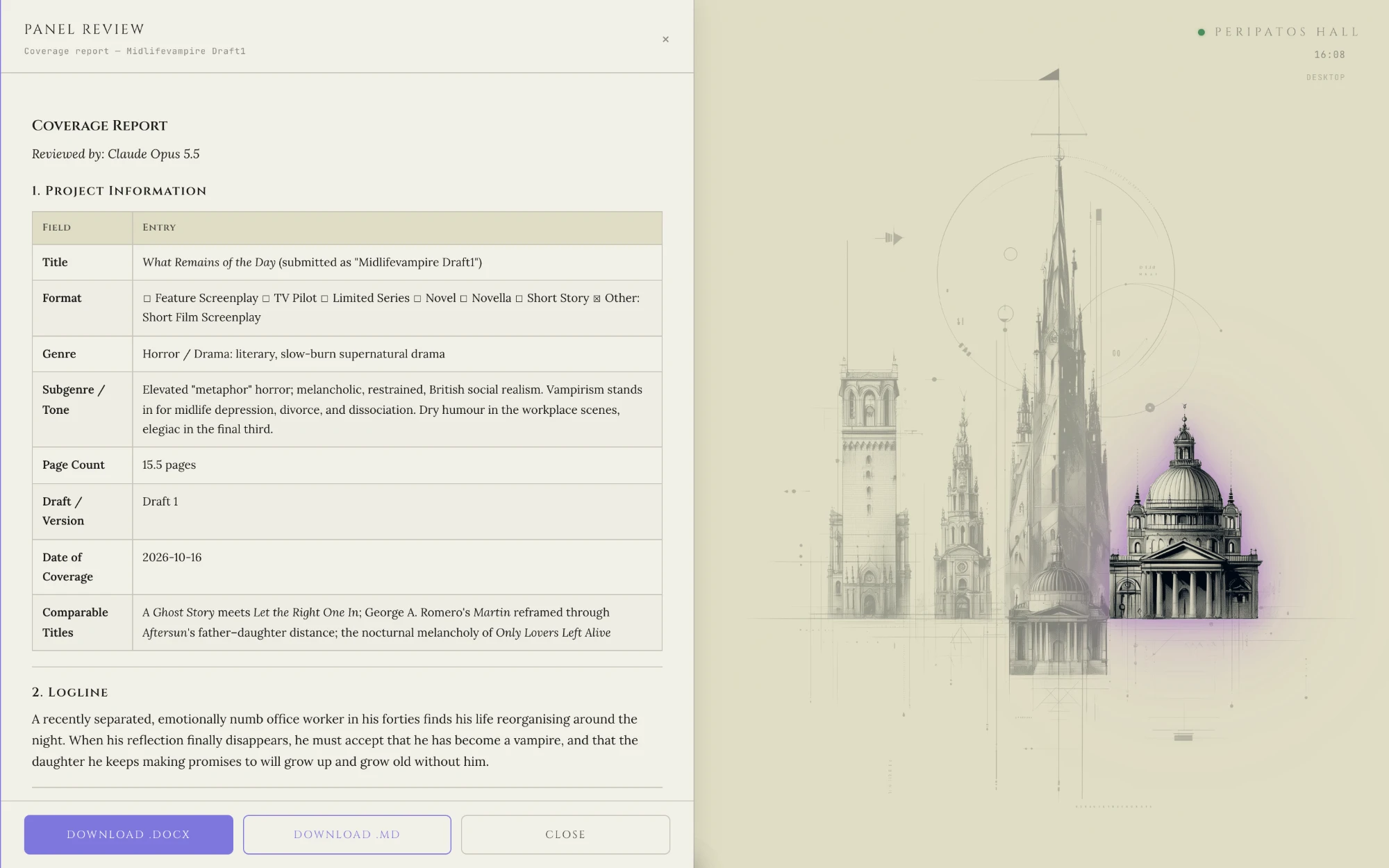
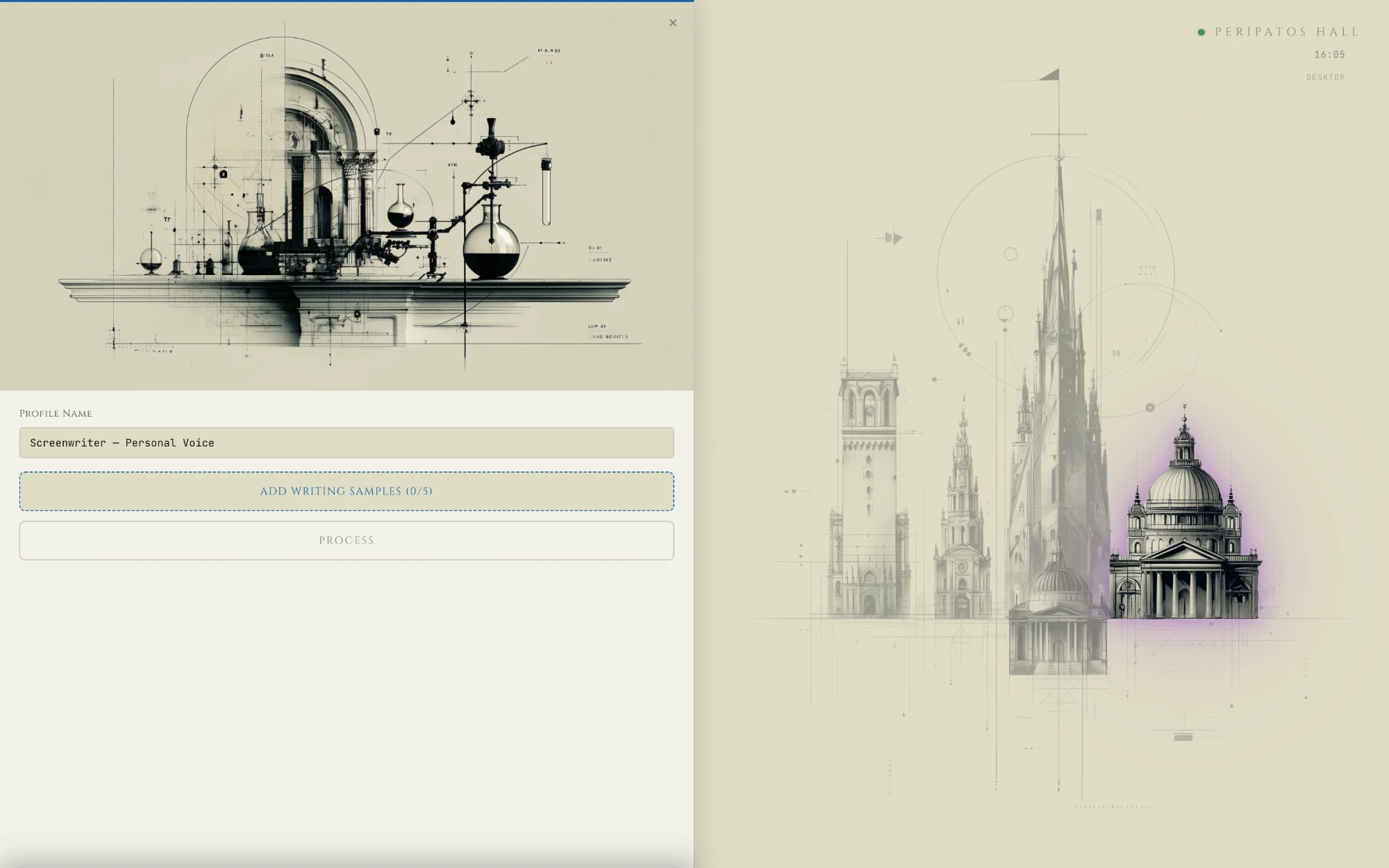
The Hall is made of a set of agents and tools, each with one job. Aurelius, in the spire, is the Hall’s orchestrator: ask him what the Hall knows about something and he searches the library and answers with a synthesis. The two towers hold the scholarship written by the Hall’s resident thinkers: Seneca (philosophy), Augustine (theology), Gibbon (history), Oppenheimer (physics) and Darwin (the sciences) in the Intellectual Pod, and Hamilton, Kennan and Sherman (politics, foreign policy and military history) in the Geopolitics Pod. The Library is run by Eratosthenes, who answers questions by connecting documents across fields, and Dewey, who maps each collection into a domain summary. The Creative Hub is a writers’ room. Scheherazade conducts it, bringing in Homer for myth and archetype, Asimov for technology and speculation, Tolkien for world-building and Stoker for dread. Salinger writes every page, and Perkins edits. Around the room sit the production tools: Panel Review, which produces industry-style script coverage; Compile, which stitches sequences into a full draft; a Perkins full pass for whole-script edits; and Writer Profiles, which learn a writer’s voice from their own samples so the drafts sound like them.

Aurelius answering what the library has learned about vampires across history, theology and philosophy B Aurelius
The spireScreen
Aurelius — synthesising what the Hall knows
Screen
The Intellectual Pod tower opened to Gibbon's shelf of fourteen history documents C Intellectual Pod
Gibbon’s shelfScreen
The history tower — Gibbon’s shelf
Screen
The Library: Eratosthenes connecting theology and history across the collection D The Library
EratosthenesScreen
The Library — Eratosthenes connecting theology and history
Screen
The Creative Hub: screenplay projects, the Workshop and the production tools E Creative Hub
The domeScreen
The Creative Hub — projects and production tools
Screen

Under the Drawing

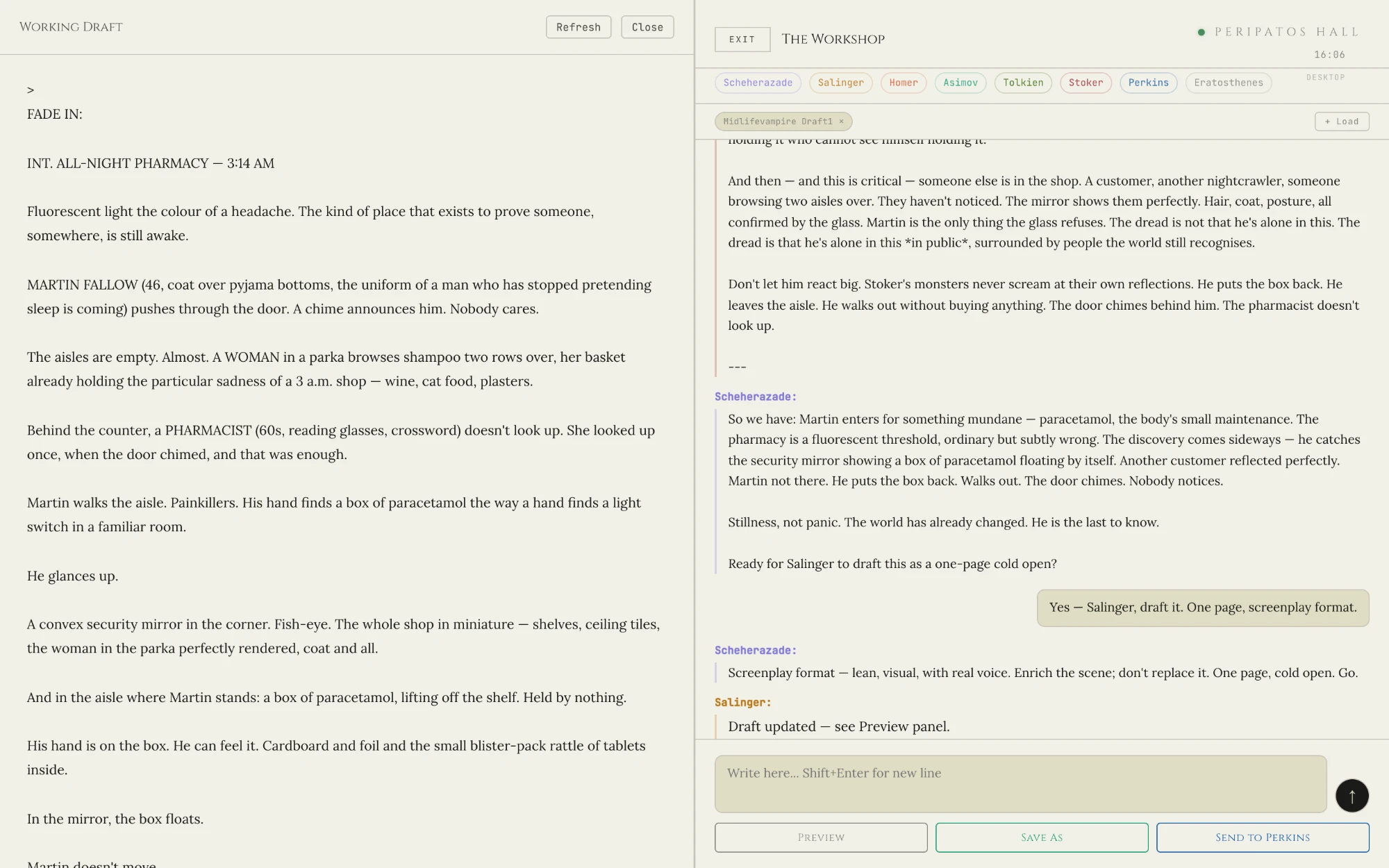
Under the drawing, the Hall is a React front end and a Python (FastAPI) back end running on a Mac mini at home, reachable from anywhere through a private sign-in. Every collaborator runs on Anthropic’s Claude, and the model fits the job. Claude Opus 4.6 does the craft work (the writers’ room, Salinger’s drafting, Perkins’ edits). Claude Opus 5.5 is the Panel’s deliberately different “outside reader”. Sonnet handles Aurelius’s and Eratosthenes’ judgment calls, and Haiku does high-volume work such as Dewey’s summaries. The library is plain Markdown that’s indexed automatically as documents arrive, so every agent can search it, cite it and build on it. In the Workshop I load a project, talk through a scene, and Scheherazade gathers each specialist’s view. Nothing gets drafted until I say so. Then Salinger writes into a live preview in Fountain screenplay format, with page counts calibrated to industry pagination. The rule underneath it all is that the voice on the page should enrich a scene that’s really happening on screen, never replace it.

Architecture diagram: Aurelius orchestrating the pods, the Library and the Creative Hub F Architecture
Orchestration flowDiagram
Architecture — the orchestration flow
Diagram
The Workshop on Midlife Vampire: Scheherazade conducting the room while Salinger's cold open appears in screenplay format G The Workshop
Midlife VampireScreen
The writers’ room at work — the conversation on the right, Salinger’s draft live on the left
Screen

The Walking School

The long-term goal is for the Hall to become a true walking school: a place where scholarship and story feed each other. I want the scholars back at work as autonomous researchers, so that the history behind a vampire’s legend, or the politics of an imagined empire, becomes source material the writers’ room can draw on directly, and the questions a story raises send the scholars off to research again. Over time the library becomes the Hall’s long memory. Writer Profiles let every collaborator write in my voice rather than a generic one. A project can travel under one roof from a first idea to a researched world, a drafted screenplay, professional coverage and a sharper rewrite. Through all of it, the author stays the one walking the path and the agents walk beside.

Panel Review coverage report for the Midlife Vampire draft: project information and logline H Panel Review
Coverage · Opus 5.5Screen
Panel Review — industry-style coverage
Screen
The Writer Profile view: a profile name, up to five writing samples and a Process button I Writer Profile
Personal voiceScreen
Writer Profiles — the Hall learns your voice
Screen

In Action

▶ Walkthrough
Peripatos Hall · alphaVimeo
Peripatos Hall — agents collaborating on a scene
Video
04

In Development
Personal Build

Aither Horizon

A private intelligence desk for world politics, built for one reader.

The Desk

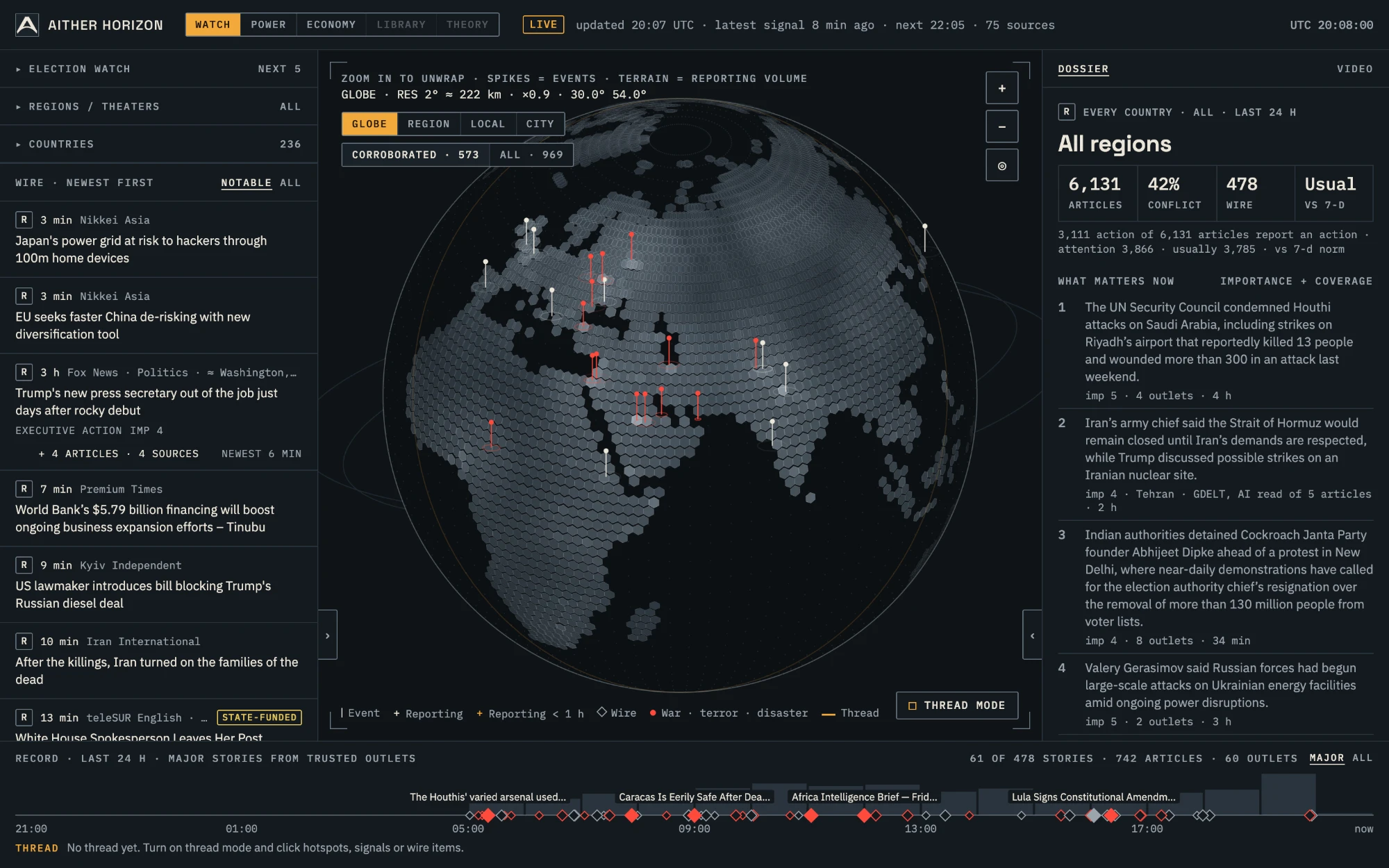
Aither Horizon is a private intelligence desk for world politics, built for one reader. It puts the whole world on a single living map and asks one question of everything it shows: is this a signal, or is it noise? Every two hours it reads 75 trusted news outlets and the GDELT event stream, which machine-codes news reports from around the world. It sorts what it finds into regions (the Americas, Asia, the UK and Europe, the Middle East, Africa) and into the theaters that matter most right now, among them the Iran war, Russia–Ukraine, China’s sphere of influence and US politics. Reported events rise from the map as spikes and reporting volume shapes the terrain, so the places that matter stand out at a glance. You can move from the whole globe down to a single city and every panel follows. Each item keeps its provenance: who reported it and when, when it happened, and when the desk saw it. State-owned and state-funded outlets are labelled as such.
Watch: the whole world on one map, with the wire on the left, the last 24 hours along the bottom and What matters now on the right A Watch
Globe · last 24 hScreen
Watch — spikes are reported events, the terrain is reporting volume
Screen
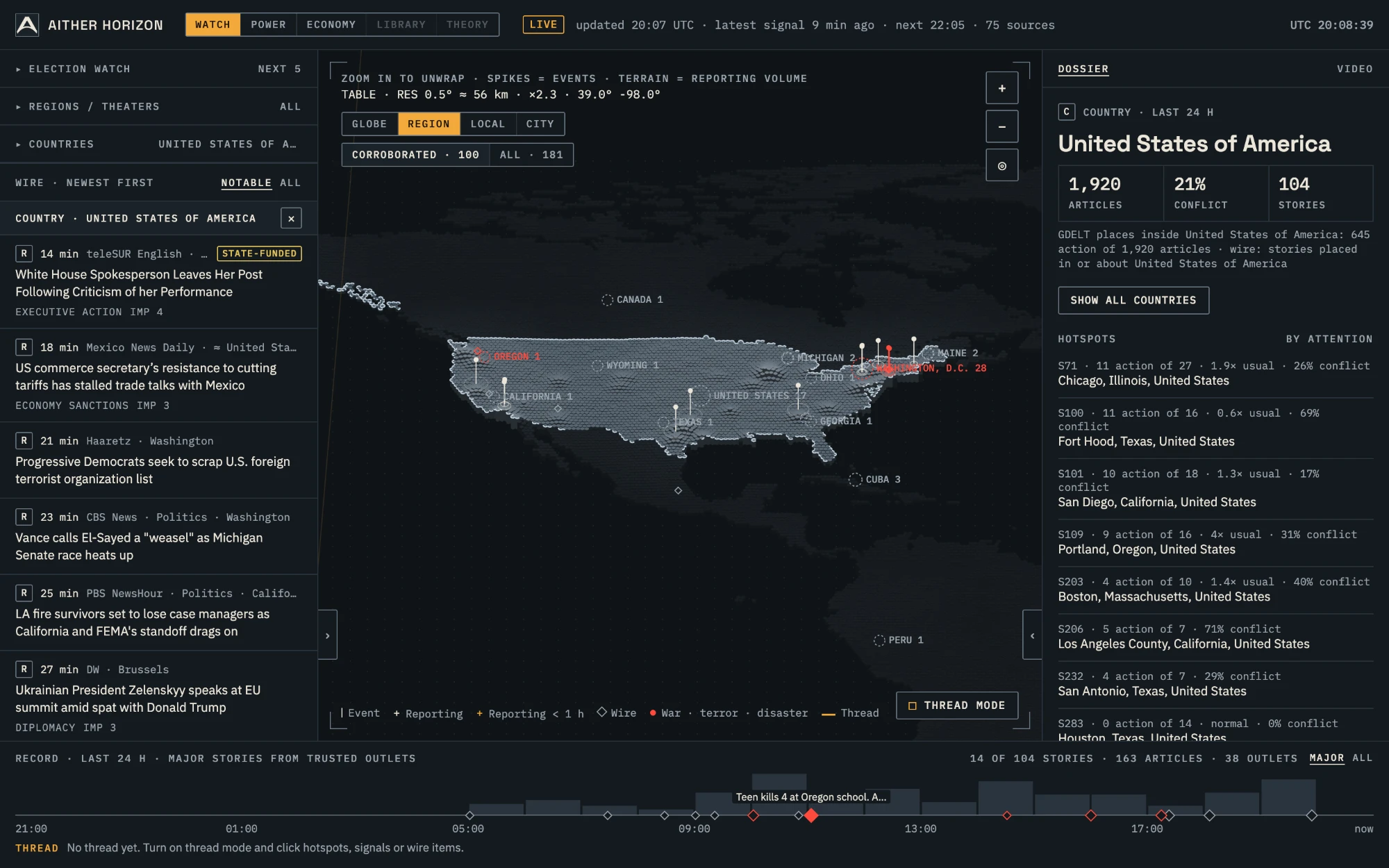
The United States at Region view, with US hotspots ranked by attention B Region
United StatesScreen
Region view — the wire and hotspots narrowed to the US
Screen
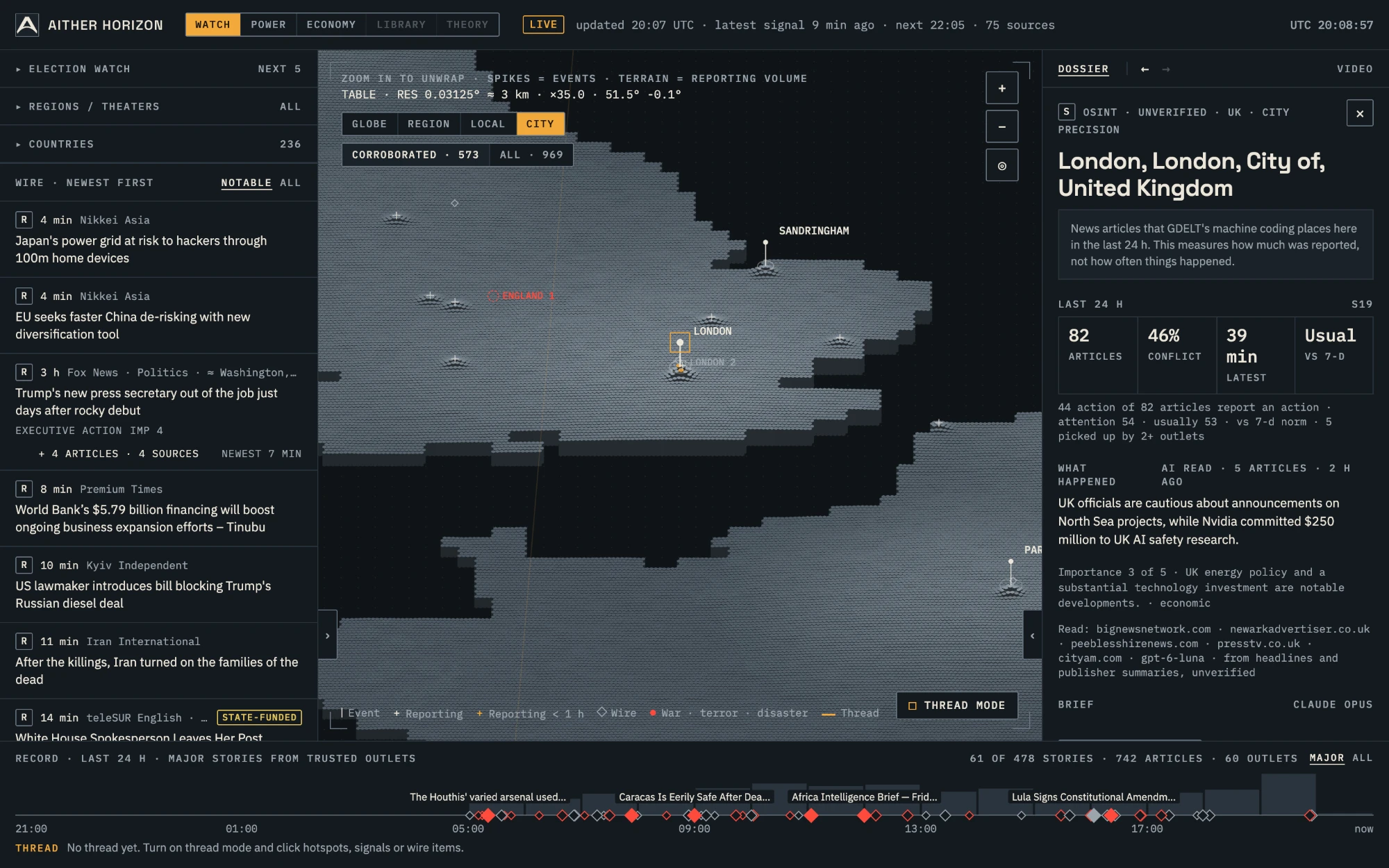
London at City view, with its dossier: what happened, from an AI reading of five articles C City
LondonScreen
City view — London, and an AI reading of what actually happened
Screen

The Modules

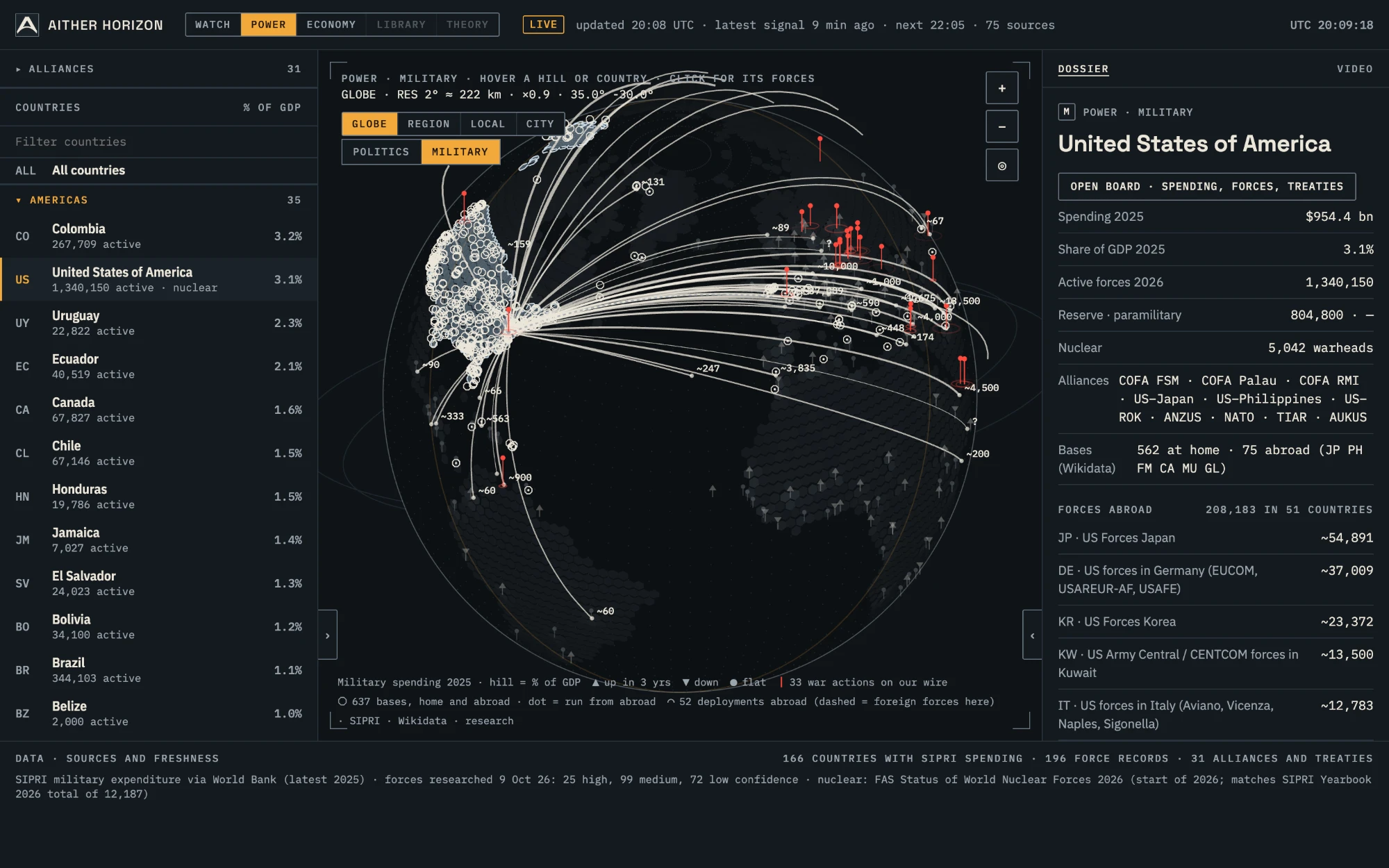
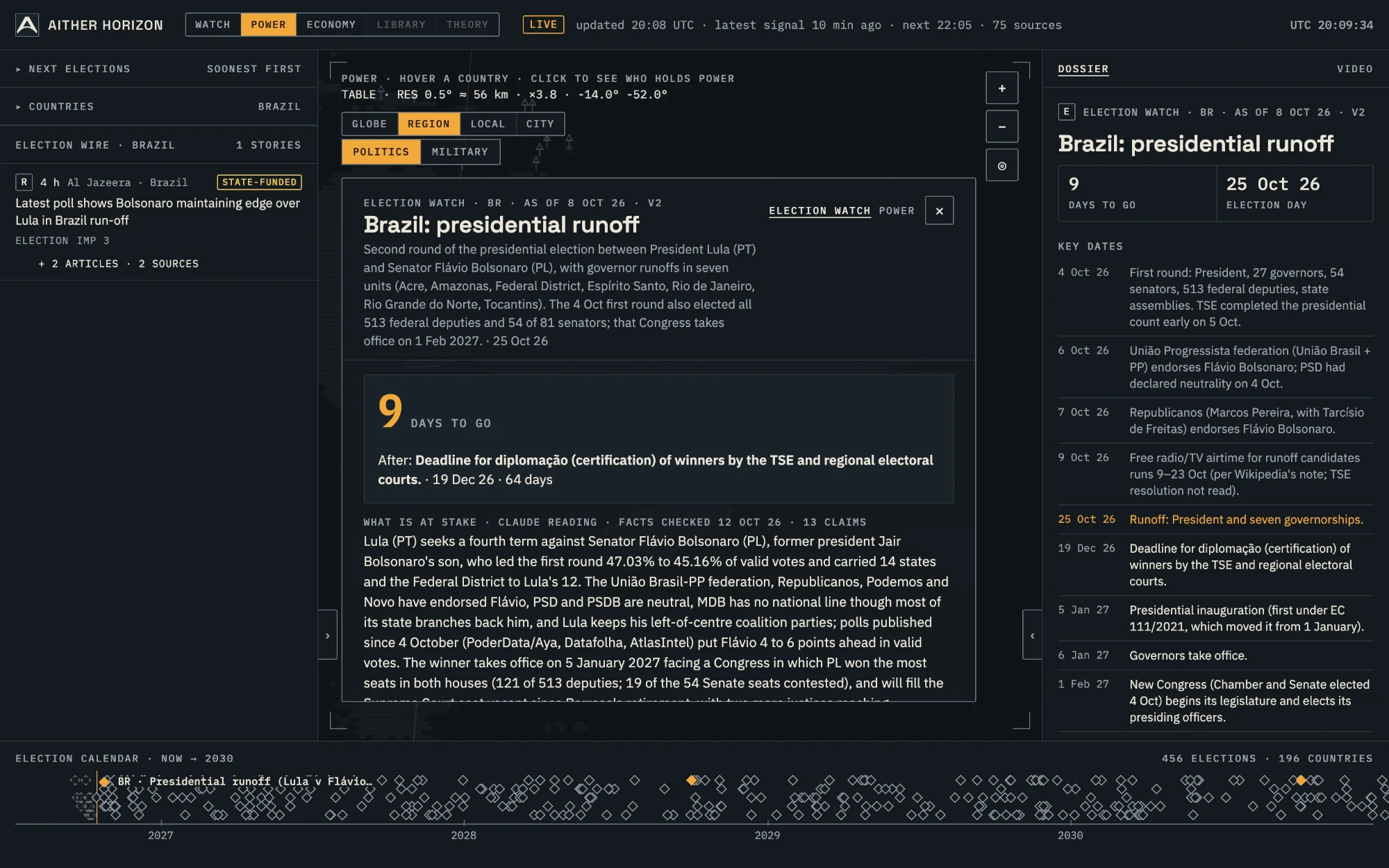
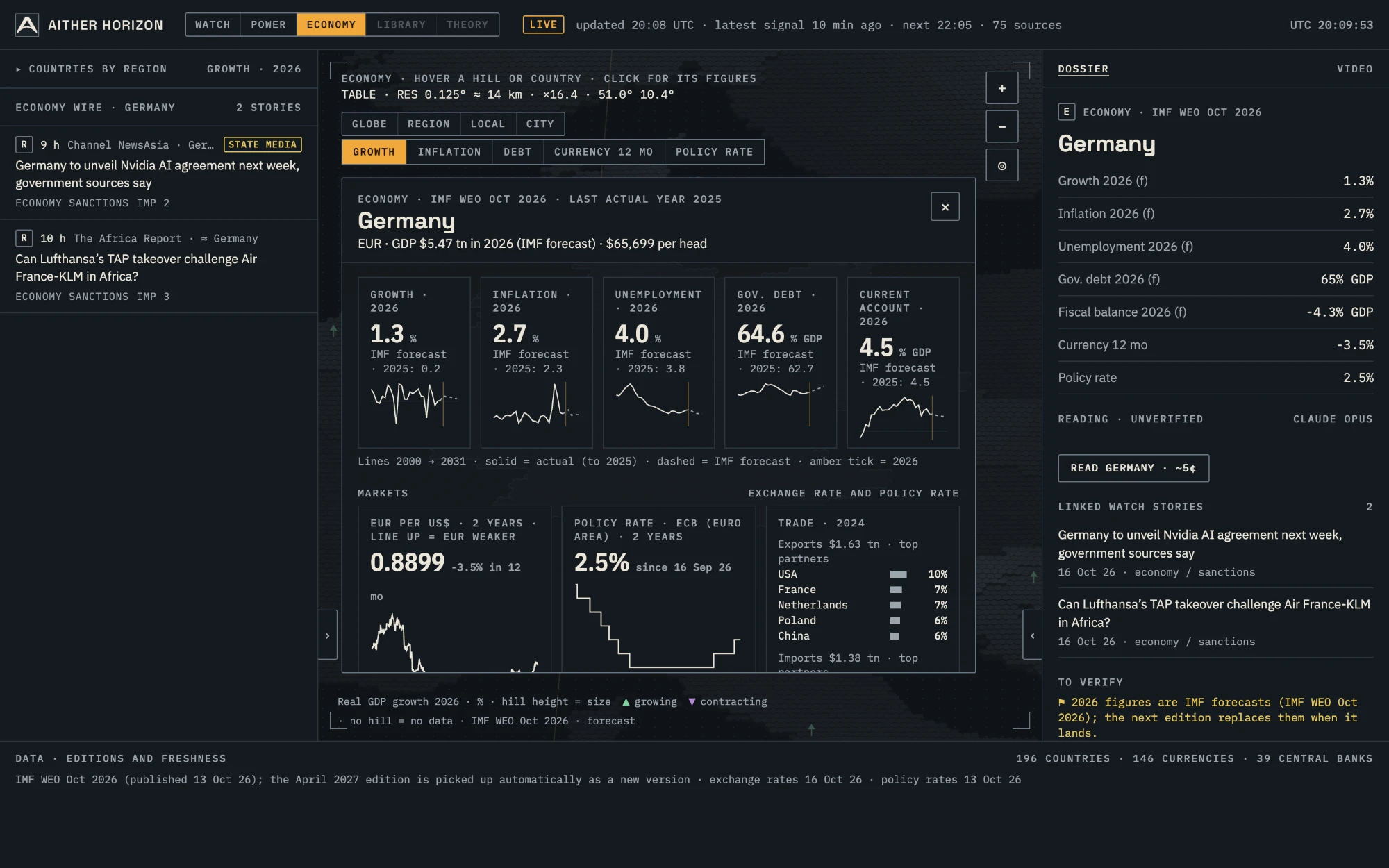
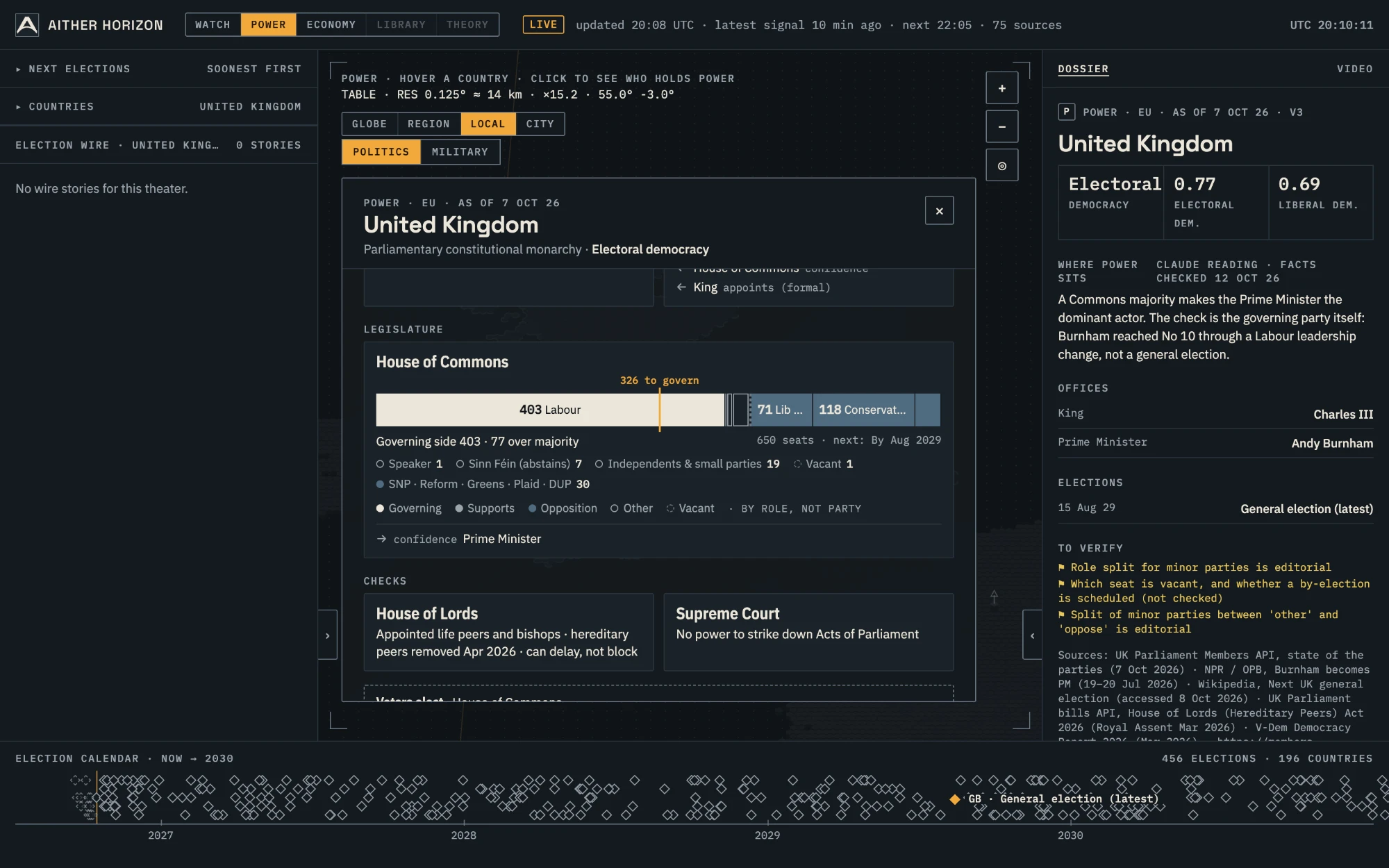
The desk is built as a set of modules, each a different lens on the same map. Watch is the live view: a ranked “what matters now” list, a wire of stories grouped across outlets, hotspots ranked by how much action is reported there, and live news channels from broadcasters around the world, playing over the map. Power shows who holds power in each of the world’s 196 countries: the head of state and the head of government, who controls the legislature seat by seat, which institutions can check them, and a short reading of where power really sits. Every profile has been checked against primary sources. Its Election Watch follows upcoming national elections with key dates, polls and what is at stake, and its Military view maps defence spending, forces, nuclear arsenals, alliances, bases and troops deployed abroad. Economy puts each country’s growth, inflation, debt, currency, interest rates and trade partners on the same globe, drawing on the IMF, the World Bank, central banks and UN trade data. Two modules are still to come: Library, a store for articles, documents and notes, and Theory.
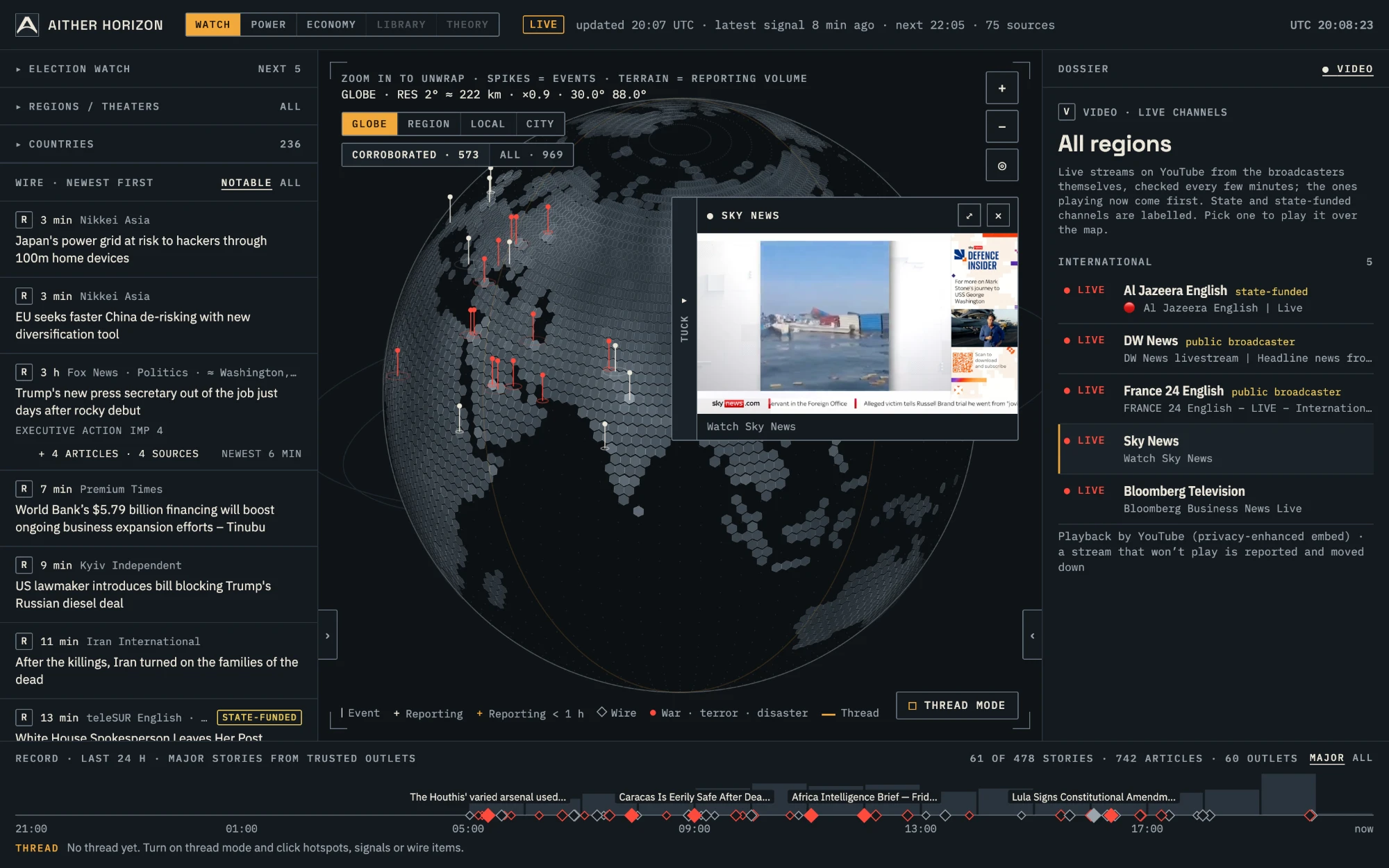
A live news channel playing over the map from the Video tab D Video
Live channelsScreen
Video — live channels over the map, state-funded ones labelled
Screen
Power, Military view: United States forces deployed abroad drawn as arcs on the globe E Military
Power · United StatesScreen
Power · Military — US forces in 51 countries
Screen
Election Watch for Brazil's presidential runoff: days to go, what is at stake and key dates F Election Watch
Brazil · runoffScreen
Election Watch — Brazil’s runoff, what is at stake, fact-checked
Screen
Economy board for Germany: growth, inflation, unemployment, debt, current account, exchange rate, policy rate and trade partners G Economy
Germany · IMFScreen
Economy — Germany’s figures, markets and trade partners
Screen
Power board for the United Kingdom: the executive, House of Commons seats by role, and the checks on power H Power
United KingdomScreen
Power — seats shaded by role, the 326 needed to govern, and the institutions that can check the government
Screen

Under the Hood

Under the hood, the desk keeps three things apart: the evidence, the machine’s reading of it, and what the reader decides. GDELT is treated only as a measure of attention, showing where the world is talking, and never as proof that something happened. A place becomes an event on the map only when an AI reading of its articles confirms something important happened there, or when a trusted outlet reports from nearby. AI models tag each article with its theater, the countries it concerns, the type of event and an importance score from 1 to 5, and they group coverage of the same story across outlets. On request, Claude writes a cited brief for any region, theater or place, with every claim linked to the article it came from. Nothing is overwritten: each profile, election record and reading is saved as a new version, with its sources and the reason for the change. Anything not yet checked against a primary source is marked “To verify”. The fact-check of every Power reading went through 1,390 individual claims.

Theory

The long-term goal is Theory: to use all of this to form, test and revise a political theory in the open. Positions will be written down as explicit claims, each tied to the evidence that supports it, the objections against it and every revision it has gone through, so the thinking itself becomes an inspectable record rather than a set of impressions. A “think tank” of AI roles (a historian, an empirical analyst, a red team and a synthesist) will argue for and against a chosen claim, citing the Library and the live record. Claims that make predictions will be scored against what actually happens on the map. The machine can propose a change of mind, but only the reader can adopt one. Watch, Power and Economy are the instruments; Theory is what they are for.

05

Public Beta
Personal Build

Lone Wolf RPG

A digital gamebook — Joe Dever’s Flight from the Dark, rebuilt for the phone.

The Game

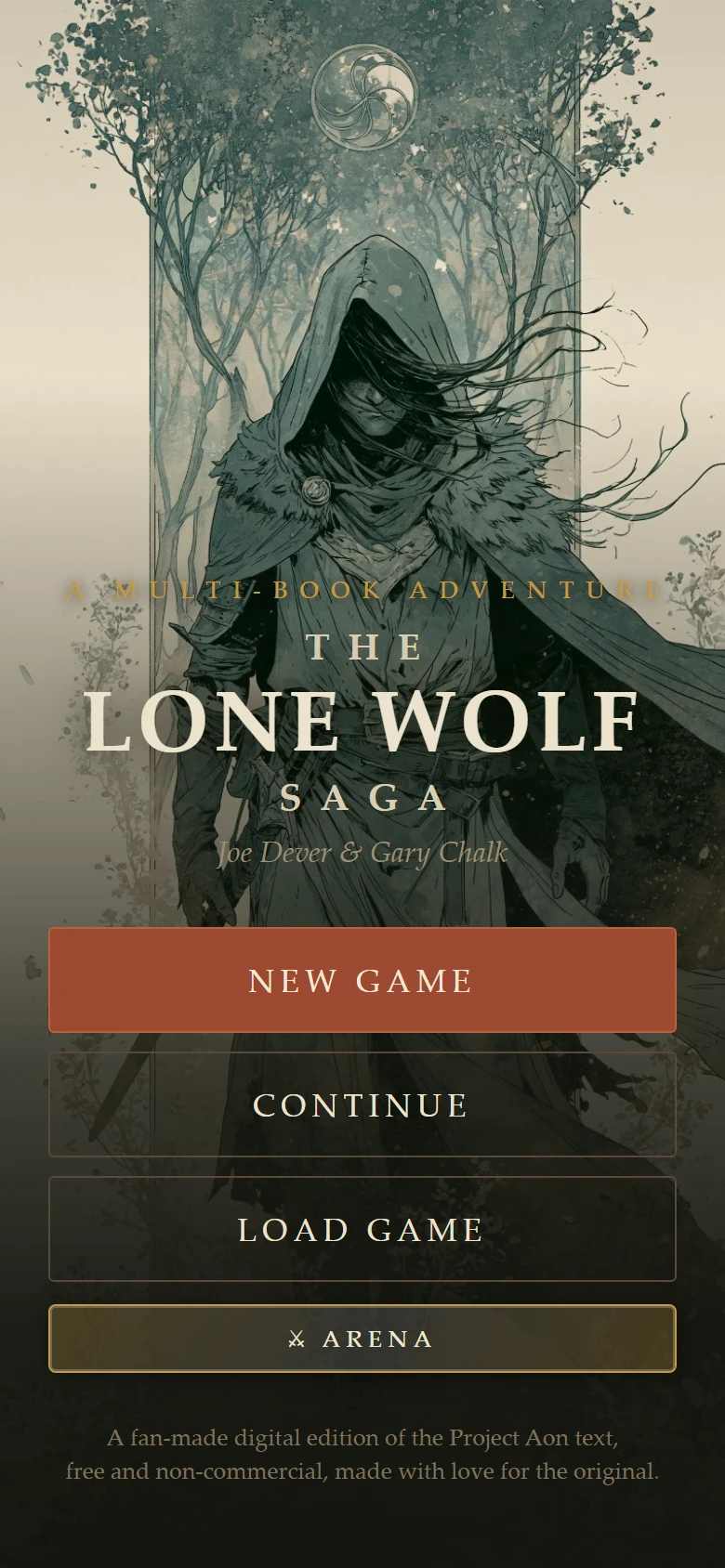
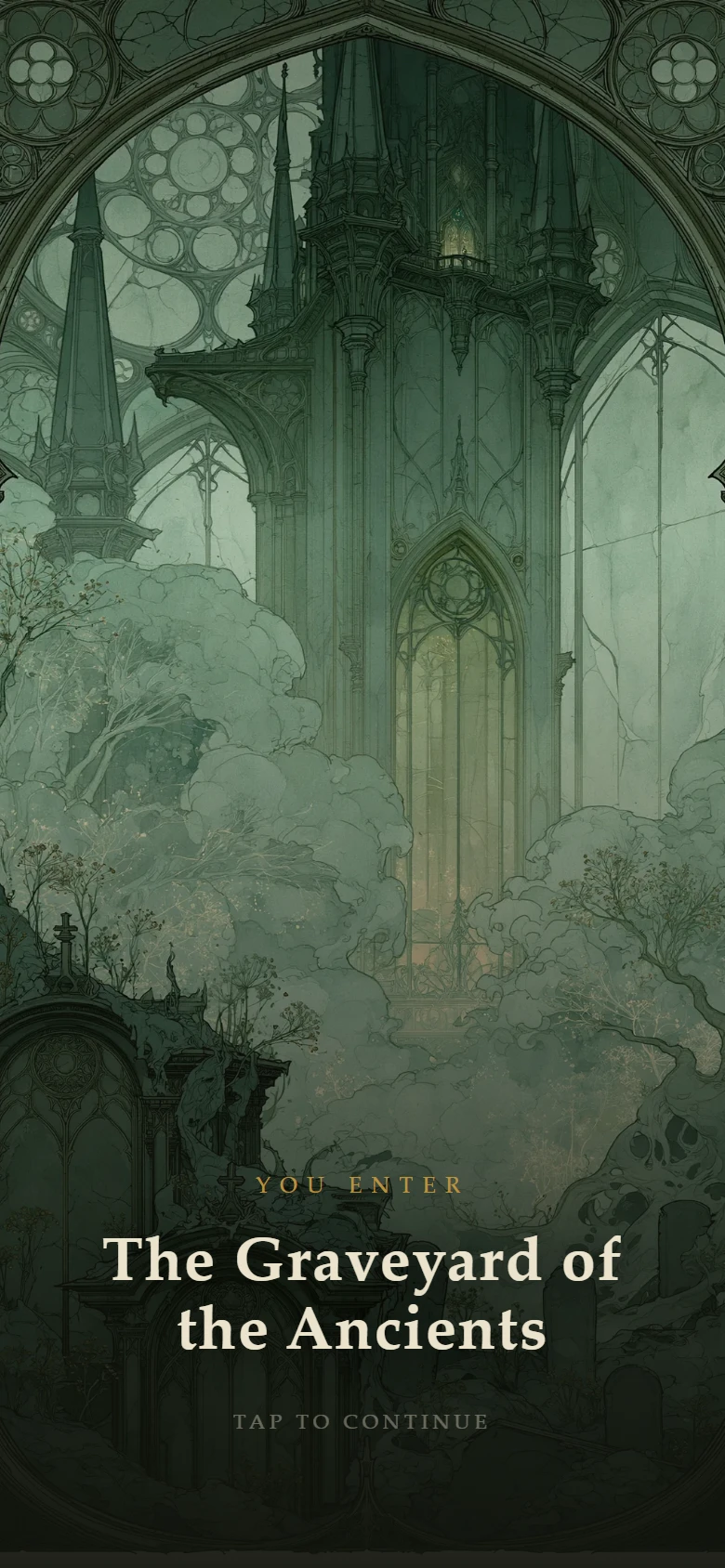
Lone Wolf is a full digital edition of Flight from the Dark (1984), the first of Joe Dever and Gary Chalk’s legendary choose-your-path gamebooks — rebuilt as a premium, mobile-first web game. All 350 sections of the original adventure are playable: you are Silent Wolf, last of the Kai, racing across Sommerlund to warn the King while the Darklords’ armies burn everything behind you. The adaptation is faithful to the book — every choice, fight, death, and secret is where Dever put it — but it plays like a modern game: a cinematic “story so far” intro, scene-setting art as you cross into each of the sixteen regions, an ambient score that shifts with the mood of the land, and a two-tap die for the blind “Roll for Fate” moments that give the series its tension. It runs in any browser, fills a phone screen edge to edge, and works offline. (Play it here.)

Title screen: The Lone Wolf Saga A
Title screen
Phone
The Story So Far: the cinematic intro B
The story so far
Phone
Zone splash: entering the Graveyard of the Ancients C
Entering a new region
Phone

The Build

The build is deliberately tiny. The entire engine is one hand-rolled HTML file — roughly 2,400 lines of vanilla JavaScript and CSS, zero frameworks, zero dependencies — and each book compiles into a single self-contained game file. A Python pipeline does the heavy lifting: a parser reads the canonical Project Aon text and converts it into structured data (sections, choices, combats, items, conditions), a curation layer layers on hand-made fixes and story-state flags, and an audit tool enforces an integrity contract — all 350 sections reachable, all 555 choice-edges verified against the book’s flow graph, every random outcome routable — and refuses to ship anything less than a clean pass. Art and music flow through the same philosophy: drop-folder tools downscale and compress each asset (watercolor illustrations, enemy plates, discipline cards, zone backdrops, eight ambient tracks) and wire them to the game by filename convention. The whole project was built in an AI-collaborative workflow — design, code, art direction, and playtesting iterated daily with Claude — with every change audited, verified in a live preview, and deployed to the edge on Cloudflare Workers in minutes.

In Play

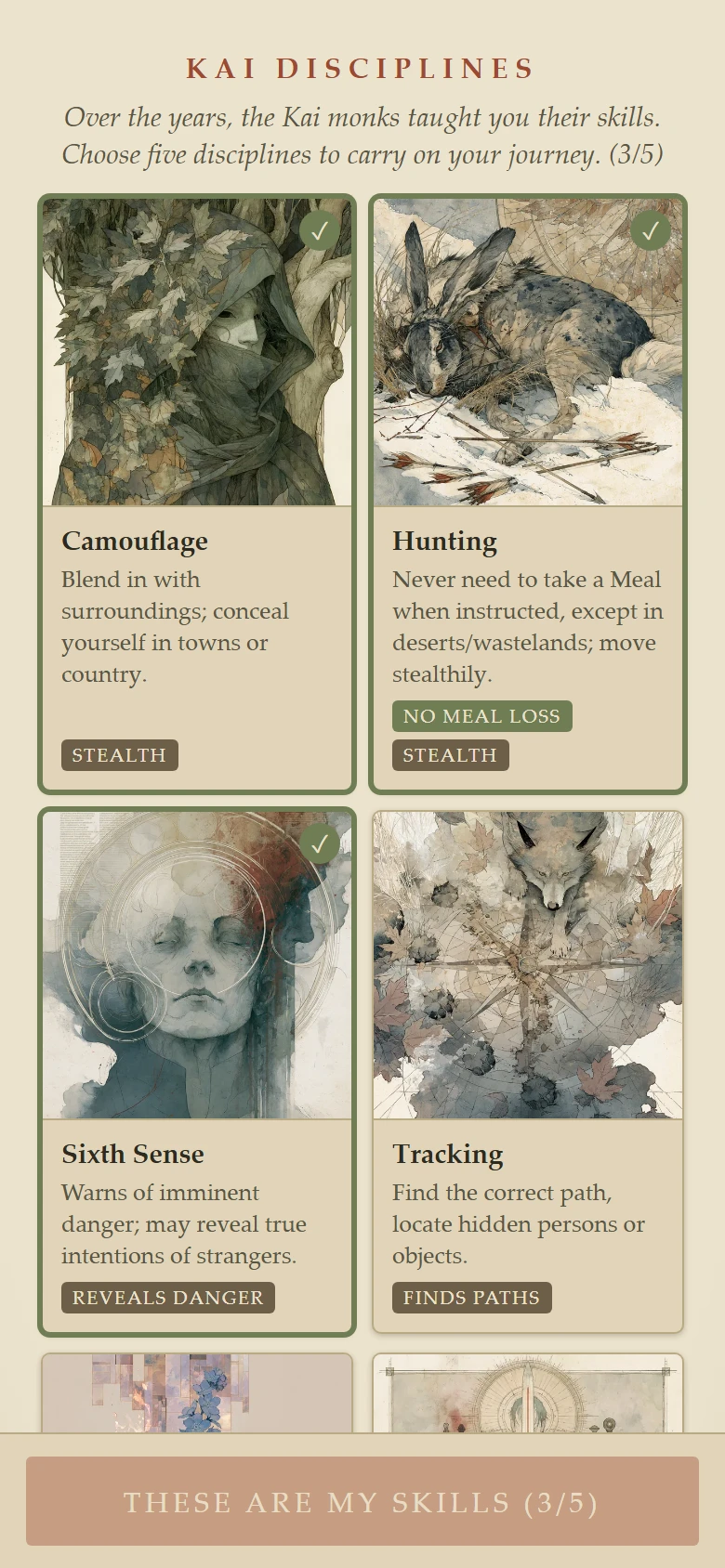
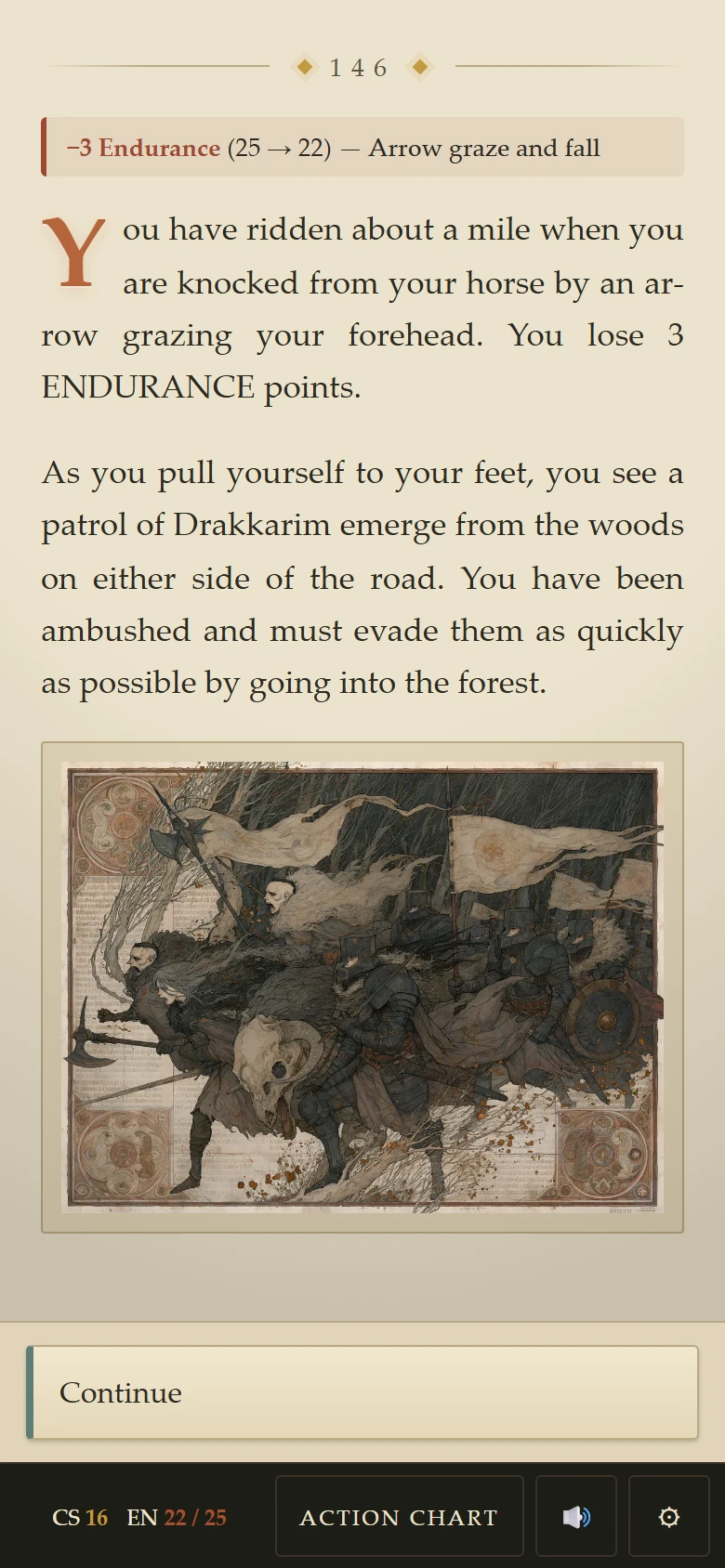
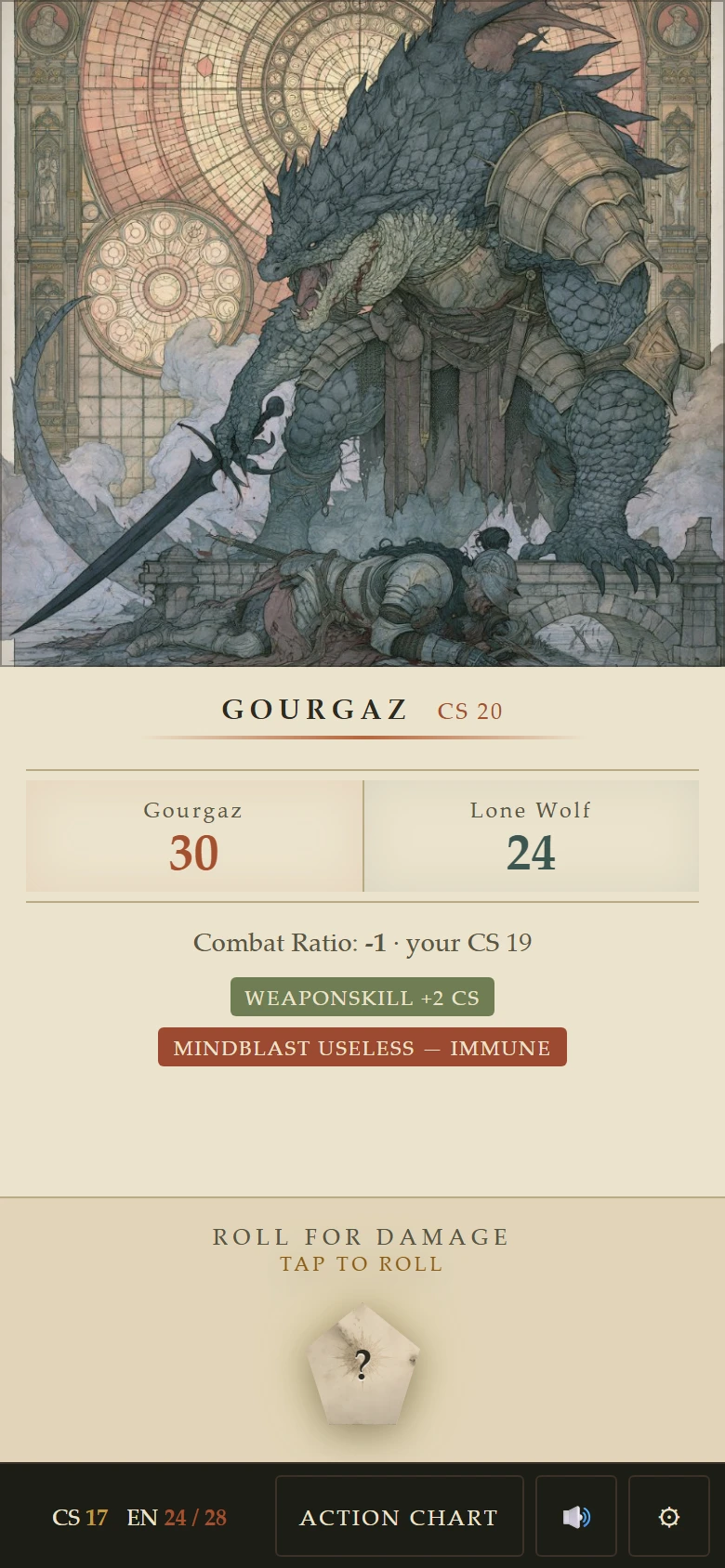
In play, the game automates the bookkeeping and preserves the choices. The original books made you track everything on a paper Action Chart; here, a live ledger announces every wound, meal, theft, and treasure with visible arithmetic, while the genuine Combat Results Table runs the fights — enemy art plates, condition chips that explain every modifier (Mindblast +2, fighting blind in the dark, a Vordak’s Mindforce sapping your skill from round two), damage numbers flying off the endurance boxes, and a SLAIN banner when a foe falls. What the game never automates is you: which weapon you ready (your Weaponskill bonus only counts if you’re actually wielding the blade you mastered), whether to risk the Graveyard of the Ancients, whether to trust the hooded ferryman. Kai Disciplines gate paths exactly as the book intends — and when you lack one, the game shows you what you’re missing, planting the seed for the next run.

Character creation: choosing five Kai Disciplines D
Choosing Kai Disciplines
Phone
A story section: the ledger, the text, an illustration and the choices E
A section — ledger, illustration, choices
Phone
Combat with Gourgaz: the enemy plate, condition chips and the die F
Combat — enemy plate, condition chips, the die
Phone

Built to Replay

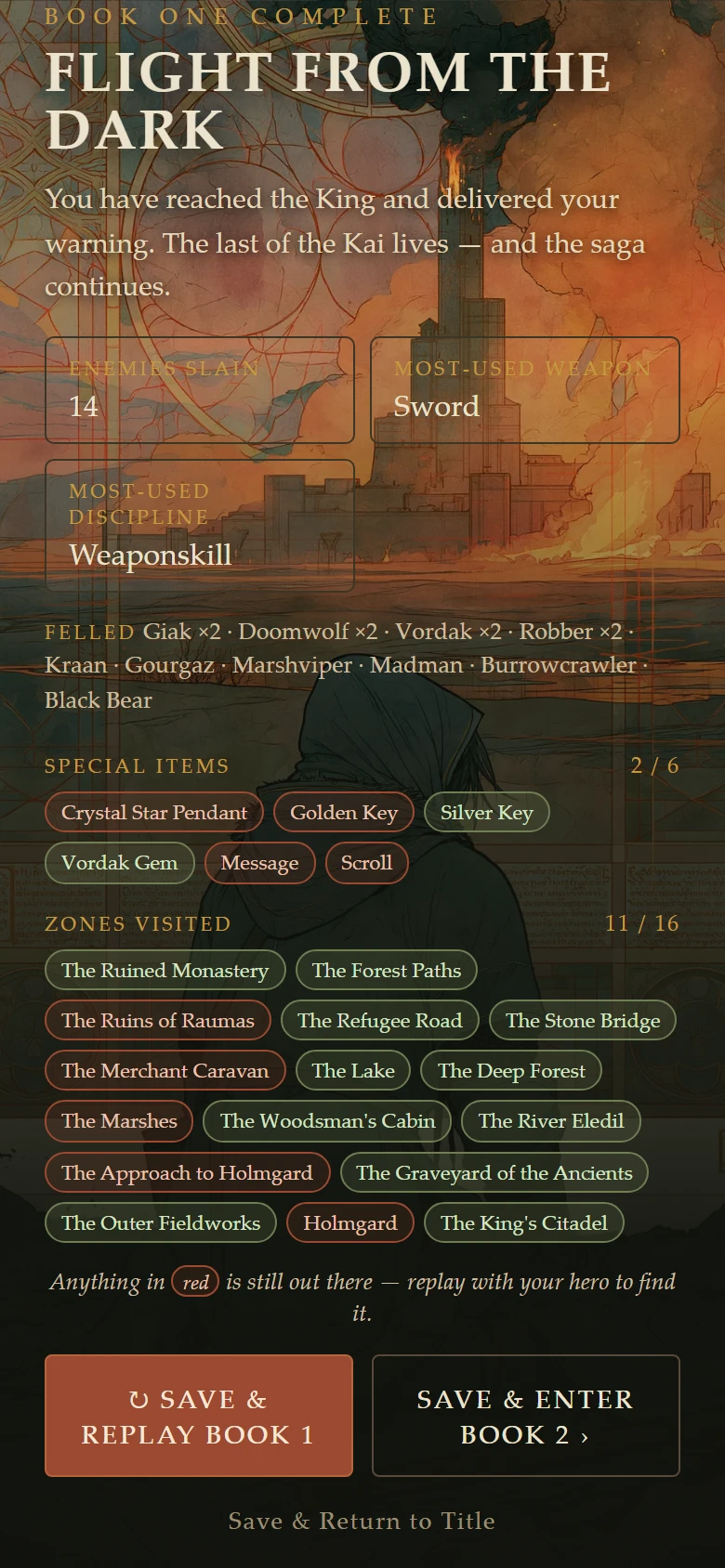
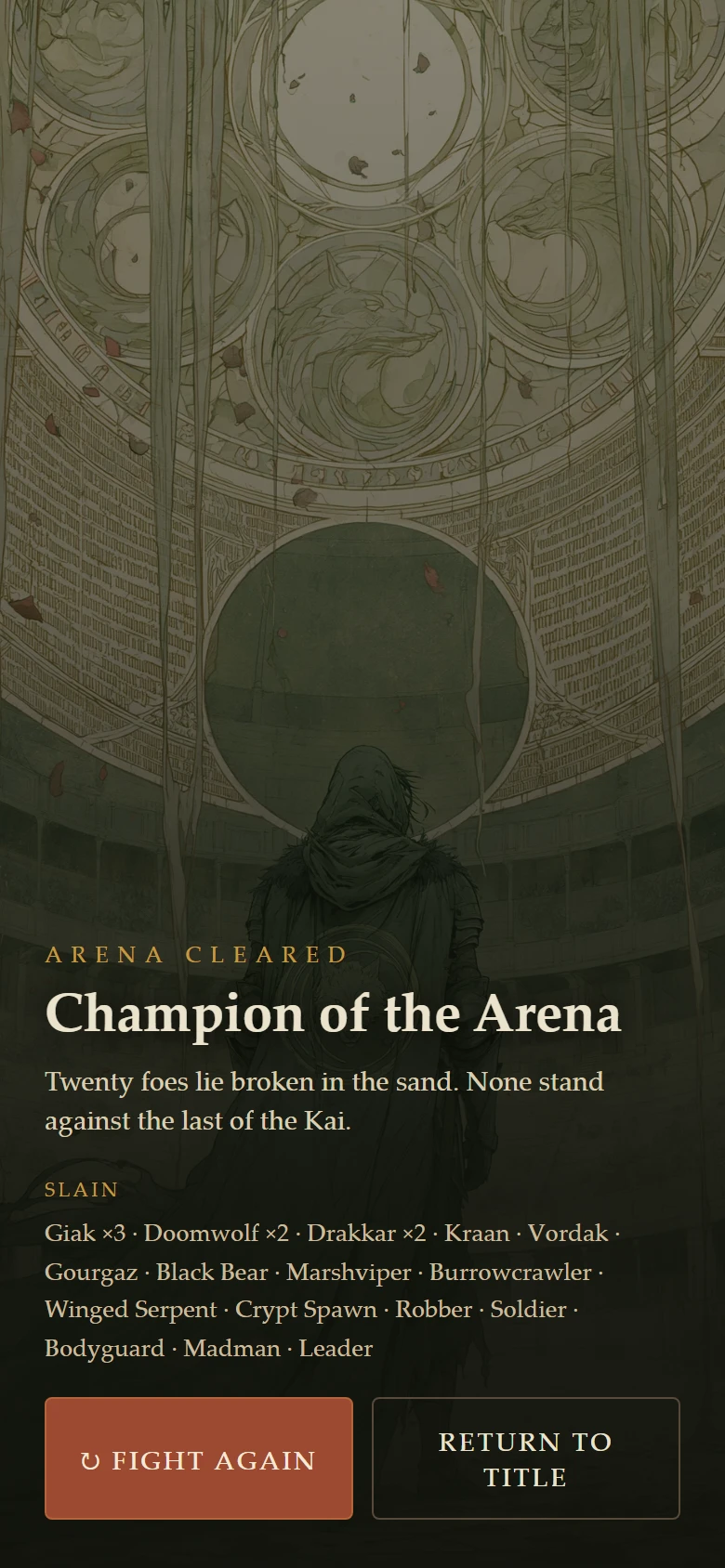
It’s built to be replayed — and to grow. Progress autosaves continuously, with named save files alongside. Finishing the book earns an illuminated epilogue: enemies felled, most-used weapon and discipline, and a collection report that shows the key items you recovered in green and the ones you walked past in red, with the same treatment for zones visited — a quiet dare to go back in. A rogue-like replay mode lets you run the book again with your veteran character (no double-dipping on unique treasures), and a standalone Arena mode distills the combat engine into a pure gauntlet: twenty escalating foes, a new Kai skill between waves, and a champion’s roster if you survive. The engine was designed from day one as a saga shell — Books 2 through 5 of the Kai series slot into the same pipeline, same engine, same save-carry-over — so Fire on the Water is a data import away, not a rewrite.

Book complete: the epilogue and collection report G
Book complete — the collection report
Phone
Arena cleared: Champion of the Arena H
Arena — Champion of the Arena
Phone

A free, non-commercial fan work. Text © Joe Dever; original illustrations © Gary Chalk; the book text is distributed for non-commercial use by the volunteers of Project Aon. This edition’s interface, art, and music are original to the project.